
Lessons for Pochettino From USMNT Second-Cycle Failures
Mauricio Pochettino has been given another opportunity to lead the United States Men’s National Team, but the next chapter will demand more than simply repeating the progress made during his first cycle.
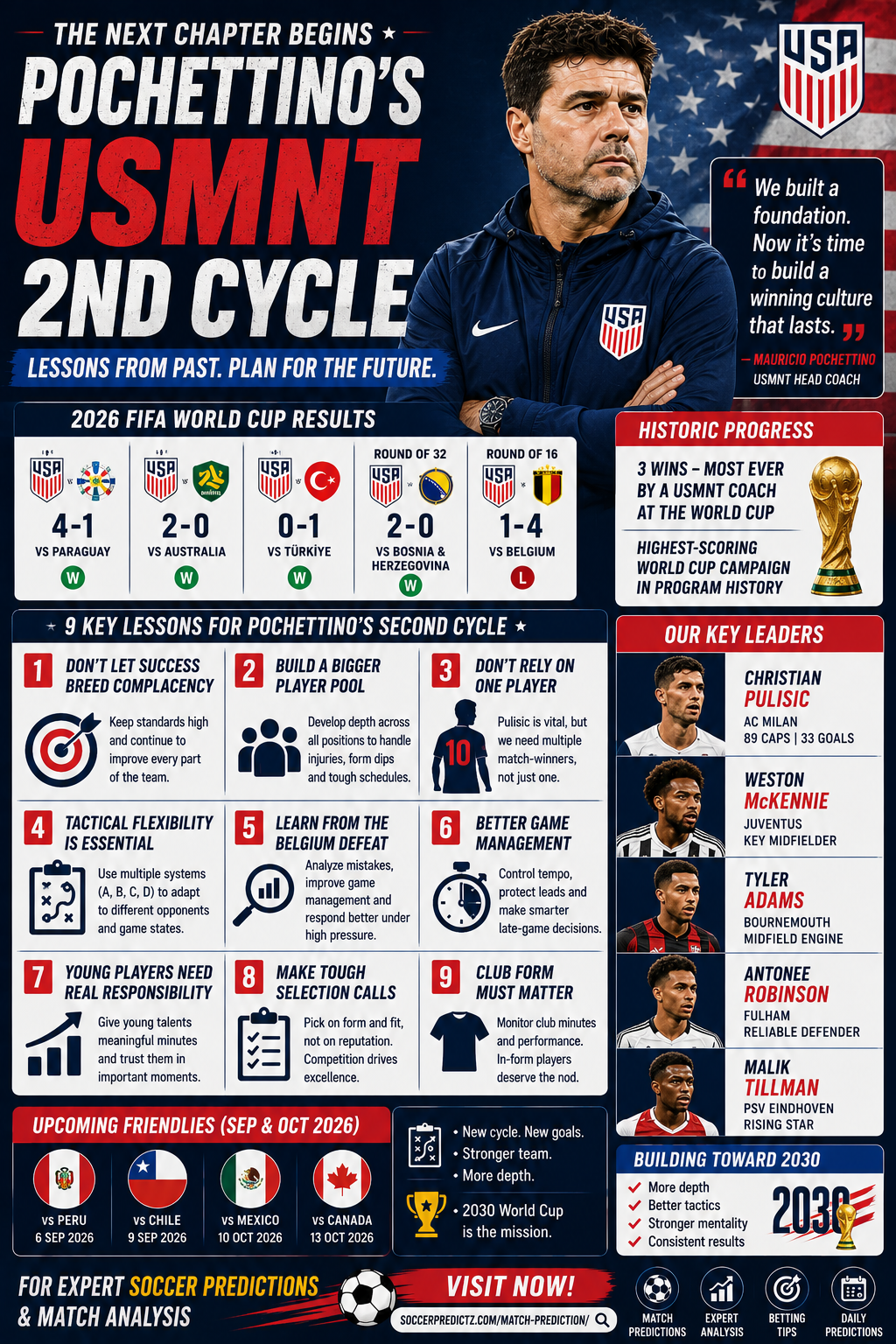
The Argentine coach guided the USMNT through the 2026 FIFA World Cup on home soil, where the United States topped its group, defeated Bosnia and Herzegovina in the Round of 32 and ultimately exited with a 4-1 defeat to Belgium in the Round of 16. U.S. Soccer noted that Pochettino’s three World Cup victories are the most ever recorded by a USMNT manager at the tournament.
Those achievements provide a foundation.
But they also expose the biggest challenge facing Pochettino.
The USMNT now needs to turn encouraging tournament performances into sustained competitiveness against the world’s strongest teams. A second cycle cannot simply be an extension of the first. It has to be an evolution.
The history of the national team provides several warnings. Previous coaching eras demonstrated how promising first phases can become complicated when expectations rise, tactical solutions become predictable, player development slows and difficult decisions are delayed.
Pochettino therefore enters his second cycle with an unusual advantage: he already knows the players, the football culture and the demands surrounding the program.
The question is whether he can learn from what went wrong before him.
For football supporters, analysts and readers interested in soccer prediction, the next USMNT cycle will be particularly important. Player development, tactical changes and squad selection will all influence how the United States performs in upcoming international fixtures.
For expert match prediction, football previews and tactical analysis, visit:
SoccerPredictz Match Prediction Hub
The First Pochettino Cycle Delivered Progress — But Not Enough
Pochettino’s first USMNT cycle should not be described as a failure.
The team showed clear signs of improvement.
At the 2026 World Cup, the United States defeated Paraguay 4-1, beat Australia 2-0, lost narrowly to Türkiye in the group stage and then defeated Bosnia and Herzegovina 2-0 in the Round of 32 before the Belgium defeat.
The team also produced its highest-scoring World Cup campaign in program history before losing to Belgium.
That is meaningful progress.
However, the Round of 16 defeat demonstrated the gap that remains.
Belgium scored twice before halftime and eventually won 4-1. Malik Tillman equalized temporarily for the United States, but the USMNT could not maintain control after falling behind again.
That performance provides Pochettino with perhaps the most important lesson of all:
Improvement is not the same as completion.
The next cycle must be about closing the gap.
Lesson One: A Strong Start Cannot Become Complacency
One of the biggest dangers in international football is assuming that a successful tournament automatically proves the underlying system is complete.
It does not.
Pochettino’s USMNT showed that it can produce aggressive, entertaining football.
The team scored four against Paraguay and managed difficult moments against Bosnia despite playing with 10 men after Folarin Balogun’s dismissal.
But the Belgium match showed what happens when an opponent is able to challenge the United States physically, tactically and psychologically.
The second cycle must therefore begin with a critical assessment of what worked and what did not.
Pochettino should avoid simply protecting the players who helped him reach the World Cup.
Competition for places needs to remain intense.
Lesson Two: Build a Bigger Player Pool
International football does not provide managers with the same training time as club football.
That makes squad depth essential.
During the 2026 World Cup, Pochettino had established players such as:
- Christian Pulisic
- Weston McKennie
- Tyler Adams
- Antonee Robinson
- Chris Richards
- Folarin Balogun
- Malik Tillman
But the next generation needs to become more than a collection of promising alternatives.
Players such as Max Arfsten, Alex Freeman, Sebastian Berhalter, Ricardo Pepi and others need meaningful opportunities.
U.S. Soccer’s World Cup roster already showed the breadth of the player pool, with the squad containing players from MLS and clubs across England, Italy, Germany, France, Spain, the Netherlands and Scotland.
The second cycle should make that pool even deeper.
Lesson Three: Never Become Too Dependent on Pulisic
Christian Pulisic remains one of the most important players in American soccer.
The AC Milan star entered the 2026 World Cup with 33 international goals and 89 caps, according to U.S. Soccer’s tournament roster information.
His creativity, experience and ability to decide matches make him extremely difficult to replace.
But that is precisely why the USMNT needs more attacking solutions.
A team preparing for 2030 cannot rely on one player to create its most important moments.
Pochettino must develop alternatives through:
- Malik Tillman
- Gio Reyna
- Ricardo Pepi
- Folarin Balogun
- Brenden Aaronson
- Tim Weah
- Emerging young attackers
The objective should not be to replace Pulisic.
It should be to ensure that opponents cannot stop the USMNT simply by neutralizing him.
Lesson Four: Tactical Flexibility Must Continue
Pochettino demonstrated during the World Cup that he is willing to adapt.
The USMNT used different structures depending on personnel and match circumstances.
That flexibility should become a defining characteristic of the second cycle.
The biggest mistake would be allowing opponents to understand exactly how the United States intends to play.
Against elite teams, tactical predictability becomes dangerous.
Plan A
Possession, aggressive pressing and quick attacking transitions.
Plan B
Compact defending followed by rapid counterattacks.
Plan C
A more direct approach when possession football becomes ineffective.
Plan D
Late-game control when protecting a lead.
The best international teams can change their approach without losing their identity.
That is the standard Pochettino should pursue.
Lesson Five: Learn From the Belgium Defeat
The 4-1 defeat to Belgium should be studied extensively rather than dismissed as one bad night.
Belgium entered the match as the ninth-ranked team in the world and had been unbeaten in its previous 18 matches, according to U.S. Soccer.
The United States struggled to reproduce the energy and control seen earlier in the tournament.
Belgium’s quality exposed weaknesses in defensive organization, game management and the USMNT’s response after conceding.
That does not mean Pochettino should completely abandon his tactical philosophy.
Instead, the coaching staff should identify why the team could not maintain its identity against stronger opposition.
That analysis could become one of the most valuable pieces of work of the entire second cycle.
Lesson Six: Develop a Reliable Plan for Game Management
The difference between promising teams and elite teams is often game management.
A team can play brilliantly for 60 minutes and still lose a knockout match.
The USMNT must learn how to manage:
- A one-goal lead
- A difficult opening period
- Momentum shifts
- Opponent pressure
- Tactical substitutions
- Late-game situations
Pochettino has extensive club experience dealing with high-pressure matches.
His challenge is transferring that experience into international football, where preparation time is extremely limited.
Lesson Seven: Young Players Need Real Responsibility
Developing young talent does not simply mean giving players five-minute substitute appearances.
They need responsibility.
The next cycle should identify players capable of becoming long-term starters and give them meaningful minutes.
Malik Tillman is an obvious example.
He scored against Belgium and had already scored in the Round of 32 against Bosnia and Herzegovina from a direct free kick. U.S. Soccer highlighted his role as one of the standout performers of the tournament.
The second cycle should ask whether Tillman can become a central figure rather than simply an emerging talent.
The same applies to players such as Arfsten, Freeman and other younger members of the player pool.
Lesson Eight: Do Not Delay Difficult Selection Decisions
One lesson from previous USMNT cycles is that sentiment can sometimes influence squad selection.
International managers cannot afford that.
Players should be selected because they fit the tactical plan and are performing at the required level.
Reputation should not guarantee a starting position.
That principle becomes even more important as the USMNT’s player pool grows.
If a younger player is performing better than an established veteran, the younger player should have an opportunity.
Competition creates improvement.
Lesson Nine: Club Form Must Matter
International coaches have limited opportunities to train their teams.
Therefore, club form becomes extremely important.
Pochettino should monitor:
- Minutes played
- Goals
- Assists
- Defensive actions
- Passing efficiency
- Tactical role
- Injury history
- Club-level consistency
A player who is struggling for his club may not automatically deserve a starting role for the national team.
This is especially important when preparing for major tournaments.
Top 10 Soccer Prediction Keywords
The following high-value soccer prediction keywords are naturally integrated throughout this article:
- Soccer prediction
- Match prediction
- Football prediction
- Today soccer prediction
- Expert soccer prediction
- Football betting tips
- Soccer betting tips
- Correct score prediction
- Winning football predictions
- Daily football prediction
These keywords connect USMNT tactical analysis with readers searching for football forecasts, team news and upcoming match previews.
How the USMNT Second Cycle Affects Soccer Prediction
The second Pochettino cycle will also have an impact on international soccer prediction analysis.
Prediction models often rely on:
- Recent form
- Player availability
- FIFA ranking
- Expected goals
- Defensive record
- Home advantage
- Squad depth
- Historical results
- Tactical matchups
As the USMNT develops, these variables could change significantly.
For example, if younger players become regular starters at major European clubs, the United States could enter future tournaments with greater squad depth.
That would naturally improve the team’s profile in football prediction models.
The Next Generation Around Pulisic
The USMNT’s future should not depend entirely on one generation.
Pochettino needs a bridge between established leaders and emerging players.
The current core includes:
Christian Pulisic
The attacking leader and most internationally experienced star.
Weston McKennie
A versatile midfielder who started all five World Cup matches for the United States.
Tyler Adams
A key defensive midfielder whose availability can dramatically influence the team’s balance.
Antonee Robinson
A high-level full-back capable of contributing at both ends of the pitch.
Malik Tillman
A player who emerged as one of the tournament’s attacking threats.
The second cycle must gradually introduce more players around them.
The Importance of European Club Development
The USMNT’s rise has been strongly connected to the increasing number of American players competing in Europe.
The 2026 World Cup roster included players from:
- AC Milan
- Juventus
- Fulham
- Crystal Palace
- PSV Eindhoven
- Bayer Leverkusen
- Monaco
- Marseille
- Celtic
- Borussia Mönchengladbach
That international exposure is valuable.
However, playing in Europe alone is not enough.
Players need regular minutes and meaningful tactical responsibilities.
Pochettino’s staff should therefore pay close attention to how each player’s club role develops.
The September and October Tests Matter
The next phase begins quickly.
The USMNT has scheduled friendlies against Peru, Chile, Mexico and Canada for September and October 2026. Reuters reported that these matches will mark the beginning of Pochettino’s next phase with the national team.
These fixtures are more important than they may initially appear.
They provide Pochettino with an opportunity to:
- Test new players
- Experiment with formations
- Evaluate young talent
- Build squad depth
- Develop tactical alternatives
The Mexico and Canada matches will be particularly useful because they provide competitive regional opponents rather than simply developmental opposition.
Why the 2030 Cycle Is Different
Pochettino now has something he did not have during the first cycle: time.
The 2026 World Cup was always approaching rapidly when he took charge.
Now, with the reported extension taking him toward the 2030 World Cup, the coaching staff can develop players over several years rather than several months. Reuters reported that Pochettino is set to lead the USMNT into the next cycle following the 2026 tournament.
That creates an opportunity for long-term planning.
The focus can move from tournament preparation to player development.
What Success Should Look Like
Success in the second cycle should not simply be measured by winning every friendly.
The real objectives should include:
- Developing a deeper player pool
- Improving performances against elite opposition
- Creating tactical flexibility
- Producing consistent attacking football
- Improving defensive organization
- Developing younger players
- Building knockout-stage confidence
If those improvements occur, tournament results should follow.
Final Thoughts
Mauricio Pochettino’s first USMNT cycle ended with disappointment but also genuine progress.
The United States topped its 2026 World Cup group, defeated Bosnia and Herzegovina in the knockout stage and produced the program’s highest-scoring World Cup campaign before losing 4-1 to Belgium in the Round of 16.
That is a platform—not a finished product.
The biggest challenge of the second cycle will be avoiding the mistakes that have affected previous generations. Pochettino must keep selection competitive, expand the player pool, develop alternatives to Christian Pulisic, improve game management and build tactical solutions for elite opponents.
The next four years should also be used to turn promising young players into established internationals.
Players such as Malik Tillman, Max Arfsten, Alex Freeman and others now have an opportunity to become central figures rather than squad options.
The upcoming friendlies against Peru, Chile, Mexico and Canada will provide the first opportunity to see how Pochettino approaches that challenge.
For fans following soccer prediction, football prediction, and match prediction, the second Pochettino cycle will be particularly interesting because the USMNT’s trajectory is no longer purely about potential.
The expectation is now performance.
The first cycle proved that the United States can compete.
The second cycle must prove that it can consistently win when the pressure is highest.
Internal Link
SoccerPredictz Match Prediction Hub
Related External Article
GOAL – Lessons for Pochettino from USMNT second-cycle failures
Relevant External Official Source
U.S. Soccer – USMNT Official Website
U.S. Soccer’s official World Cup coverage confirms the USMNT’s 4-1 Round of 16 defeat to Belgium, its three tournament wins under Pochettino and the team’s strong group-stage campaign.