
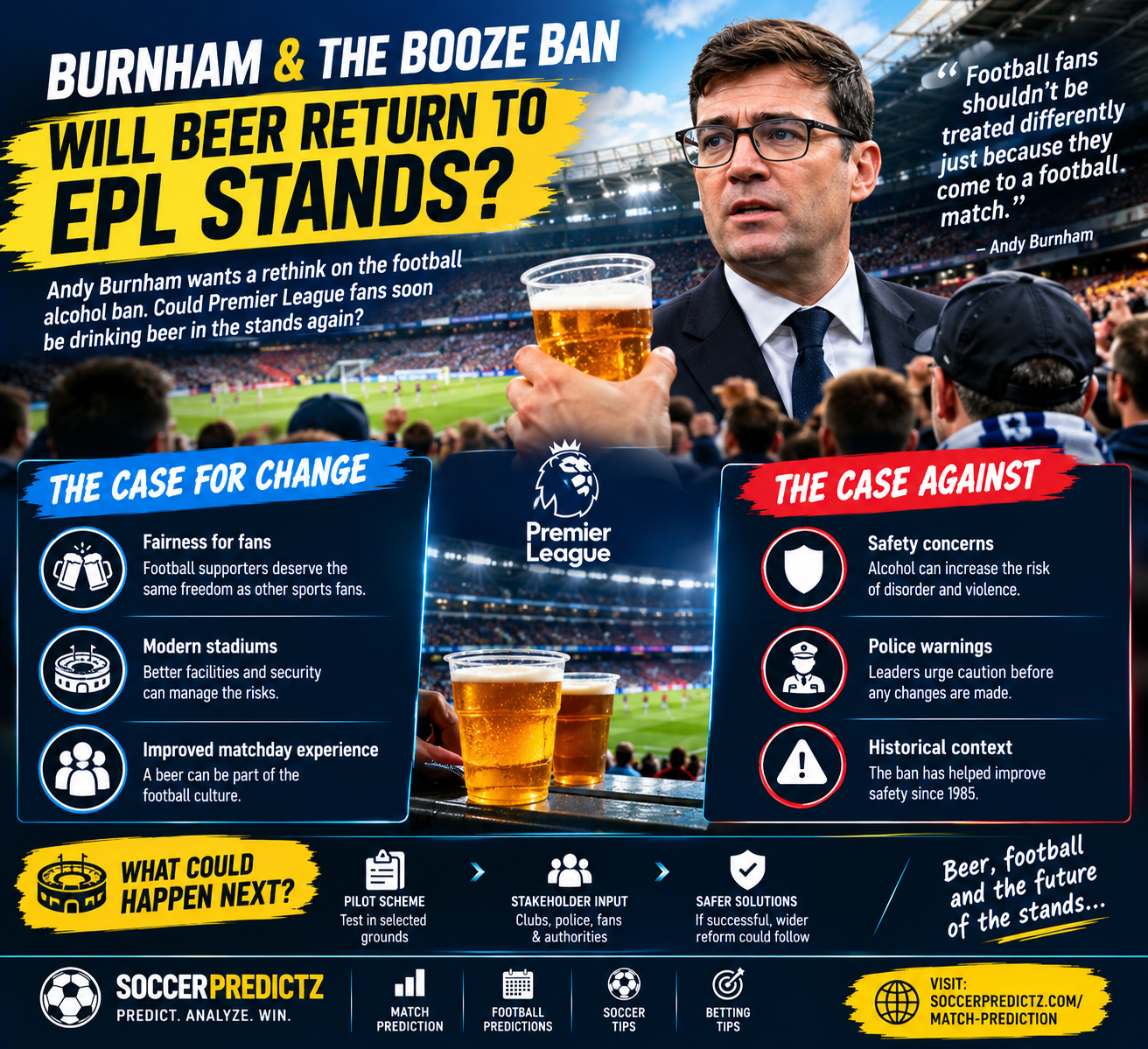
Burnham & the Booze Ban: Will Beer Return to EPL Stands?
The debate over alcohol at English football matches has returned to the spotlight after Prime Minister Andy Burnham called for a rethink of the long-standing ban on drinking in view of the pitch. The proposal has reopened a conversation about fan freedom, stadium safety and whether the rules governing football supporters remain appropriate for the modern game.
For many Premier League fans, enjoying a beer is part of the matchday experience. Supporters can already purchase alcoholic drinks at many stadiums, but restrictions prevent them from consuming alcohol while watching the action from the stands. Burnham argues that football supporters are treated differently from fans attending sports such as rugby and cricket, where drinking in spectator areas can be permitted.
However, police leaders have warned against lifting the restriction without careful consideration. The central question is whether England can create a safer, fairer and more enjoyable matchday experience without increasing the risk of disorder.
For readers following football news alongside soccer prediction and match analysis, this issue also highlights how regulations, stadium culture and supporter behaviour shape the modern football experience.
Why Andy Burnham Wants to Review the Football Alcohol Ban
Andy Burnham has argued that the current rules are outdated and unfair to football supporters. His position is based on the idea that fans should not automatically face stricter restrictions simply because they attend a football match rather than another sporting event.
The Prime Minister is also a well-known Everton supporter and has experienced the differences between football and other stadium events firsthand. His comments followed comparisons between the rules applying to football and those governing other sports.
Under the current system, supporters can buy alcohol in designated stadium areas, subject to venue rules and licensing restrictions. However, drinking in sight of the pitch is prohibited at specified matches in England and Wales across the top five tiers of men’s football.
Burnham has suggested that a review or controlled trial could help establish whether the restrictions remain necessary in their current form.
This does not mean the ban has already been removed. Any significant change would require legal and policy consideration, alongside discussions with clubs, supporters, police and other stakeholders.
The debate is therefore at an important early stage: the political argument for change is clear, but the practical details remain unresolved.
Why Was Alcohol Banned in English Football Stands?
The restrictions date back to the Sporting Events (Control of Alcohol etc.) Act 1985. The legislation emerged during a period when English football faced serious concerns about crowd disorder and hooliganism.
Football authorities and public officials were under pressure to improve safety at grounds. Restricting alcohol consumption in view of the pitch became one element of a broader approach to managing matchday risks.
Since then, English football has changed considerably. Stadium infrastructure has improved, crowd management has become more sophisticated, and clubs have invested in security, stewarding and supporter engagement.
Those developments have led some people to question whether rules introduced more than four decades ago should remain unchanged.
Nevertheless, historical context matters. The restrictions were introduced in response to genuine safety concerns, and opponents of reform argue that removing them without sufficient evidence could undermine progress.
The challenge is to determine whether modern stadium operations can safely accommodate a different approach while protecting supporters, players, staff and police officers.
What Do Police Leaders Think About Bringing Beer Back?
Police representatives have expressed strong reservations about allowing supporters to drink alcohol in the stands again.
Mark Roberts, the national lead for football policing, warned in October 2026 that reversing the restrictions would be a bad idea. He argued that football’s improved safety record reflects a combination of legislation, better stadiums and stronger engagement with supporters.
His concern is that removing one element of the existing system could create additional risks.
One potential issue is the effect of alcohol on crowd behaviour during emotionally charged matches. Football supporters can react intensely to late goals, controversial decisions, rivalries and disappointing results. Introducing open drinks into tightly packed stands could create additional problems, including spilled drinks, confrontations and difficulties for stewards.
Police leaders also point out that the consequences of disorder can extend beyond the stadium. Incidents may affect transport hubs, surrounding streets and local communities.
Supporters of reform argue that responsible fans should not be penalised for the behaviour of a minority. Police representatives, however, emphasise that any policy change must consider the collective safety of everyone attending a match.
The disagreement demonstrates why the issue cannot be resolved by political opinion alone. Evidence, consultation and practical planning will be essential.
Do Premier League Fans Actually Want Beer in the Stands?
Supporter opinion is not necessarily uniform.
Some fans believe drinking a beer while watching football is a normal part of attending a sporting event. They argue that stadiums should offer a comparable experience to rugby and cricket venues, provided appropriate safety measures are in place.
Others are comfortable with the current arrangement. They can purchase drinks before kick-off or during half-time and consume them in designated concourse areas rather than in their seats.
There are also supporters who worry that drinking in crowded stands could make the matchday experience less pleasant. Spilled beer, obstructed movement and alcohol-related arguments could affect families, older fans and people who prefer a more relaxed atmosphere.
The discussion should therefore avoid treating football supporters as one group with a single opinion.
A meaningful review would need to consider different types of grounds, ticket holders, crowd sizes, match categories and existing safety arrangements.
The most useful question is not simply whether fans want beer in the stands. It is whether any change would improve the overall matchday experience without creating unacceptable risks.
Could a Trial Scheme Be the Answer?
One possible compromise is a limited pilot scheme rather than an immediate nationwide change.
A trial could allow selected clubs to test controlled alcohol consumption in designated spectator areas under strict conditions. Authorities could then compare the results with existing arrangements.
Such a scheme would need clearly defined safeguards. These might include restrictions on drink containers, limits on sales, staff training, monitoring of crowd behaviour and a detailed process for reporting incidents.
Organisers would also need to establish measurable criteria for success. Relevant indicators could include alcohol-related incidents, ejections, medical calls, supporter complaints and the workload placed on police and stadium staff.
A trial should not be judged solely by whether serious disorder occurs. It should also assess whether the experience becomes better or worse for ordinary supporters.
If the results demonstrated that a controlled approach was safe, policymakers could consider whether wider reform was justified. If the trial revealed significant problems, restrictions could remain in place or be adjusted.
The important point is that a pilot would provide evidence rather than relying entirely on assumptions from either side of the debate.
What About Rugby and Cricket Supporters?
Comparisons with other sports are central to Burnham’s argument.
At some rugby and cricket events, spectators are permitted to consume alcoholic drinks while watching the action. Football supporters therefore question why the rules differ when modern stadiums can host multiple sports.
The comparison has some merit, but it is not automatically decisive.
Different sports have different crowd patterns, rivalries, stadium layouts and policing requirements. The size of a crowd, the nature of an event and the behaviour of supporters can all influence the risks associated with alcohol.
Football also has a distinctive history of crowd disorder, which helped shape the legislation introduced in 1985.
That history should not mean football fans must face different rules forever. Equally, the fact that alcohol is permitted at another sporting event does not prove that the same policy would be suitable for every football match.
A fair review would compare the evidence, consider the differences between sporting environments and identify which safeguards would be necessary.
Could Beer Return to Premier League Stands Soon?
Despite Burnham’s comments, fans should not assume that beer will immediately return to Premier League seating areas.
The existing legal restrictions remain in force, and changing them would require a formal process. That could involve legislative amendments, consultation with police and football authorities, and decisions about how any new rules would operate.
Even if the government supported reform, implementation would take planning. Clubs would need to review their stadium policies, licensing arrangements, staff training and security procedures.
There is also a difference between allowing alcohol in selected areas under a trial and permitting unrestricted drinking throughout a stadium.
Any future scheme could be limited to particular venues, matches or seating areas. Policymakers might also choose to maintain stricter conditions for high-risk fixtures.
For now, the possibility of reform remains a proposal rather than a confirmed change. Supporters should wait for official announcements before assuming that matchday rules will be different.
How Could the Change Affect Clubs and Stadium Operations?
Allowing drinks in the stands could affect more than the supporter experience.
Clubs would need to consider how drinks are sold, transported and consumed in seating areas. Stadium operators might need additional staff, revised procedures for handling incidents and changes to cleaning arrangements.
There could also be financial implications. A change might create opportunities for additional sales, but any extra revenue would need to be weighed against operational costs and potential risks.
Safety planning would be particularly important at grounds with narrow aisles, steep seating, limited space or large numbers of supporters moving through the same areas.
Clubs would also have to consider families and supporters who do not drink alcohol. A policy change should not make these fans feel less welcome or less safe.
The best outcome would be a system that improves choice without compromising accessibility, comfort or security.
The Wider Football Culture Debate
The alcohol discussion is part of a wider conversation about how football treats its supporters.
Fans regularly debate ticket prices, kick-off times, policing, stadium facilities and the commercialisation of the sport. Many want clubs and governing bodies to recognise that attending a match is a social and cultural experience, not simply a commercial transaction.
Burnham’s proposal appeals to those who believe football supporters should enjoy the same freedoms as people attending other sporting events.
Opponents worry that reform could place greater pressure on the safety systems that have helped make modern stadiums more secure.
Both sides raise legitimate questions. Football should avoid unnecessary restrictions where they no longer serve a clear purpose, but it must also protect the people who attend matches.
A successful policy would need to balance supporter freedom, public safety and the practical realities of managing large crowds.
What This Means for Soccer Prediction and Match Analysis
Although the alcohol debate does not directly determine match results, it is part of the wider context surrounding English football.
Readers interested in soccer predictions may follow the story because it could influence the matchday experience and stadium operations if regulations eventually change. However, it should not be treated as a direct indicator of which team will win a game.
A reliable football prediction still depends on sporting factors such as team form, injuries, tactical systems, player availability and recent performances.
When preparing a soccer match prediction, analysts should focus on how teams create chances, defend set pieces and perform against different styles of opposition.
Likewise, soccer betting tips should be based on evidence rather than speculation about potential policy changes. General football tips can help supporters understand form and tactical trends, but no prediction method can guarantee a result.
Anyone preparing a match prediction should compare recent results, team news and the strength of each opponent. Reviewing soccer odds can provide insight into market expectations, although odds are not guarantees of the outcome.
A correct score prediction is particularly difficult because even a well-fancied team can win by a range of margins or fail to score. Supporters looking for football predictions today should therefore use current team information and acknowledge uncertainty.
For more fixtures, previews and football analysis, visit the SoccerPredictz Match Prediction page.
Final Verdict: Will Beer Really Return to EPL Stands?
Andy Burnham has reopened a debate that has existed for years: should English football continue to restrict alcohol consumption in view of the pitch, or is it time to reconsider the rules?
The case for reform centres on fairness, modern stadium management and the experience of supporters attending other sports. The case against rapid change focuses on public safety, crowd behaviour and the risk of weakening safeguards that have contributed to football’s improved environment.
A carefully designed trial could help move the debate beyond competing opinions. But any pilot would need clear safeguards, transparent evaluation and meaningful input from police, clubs, staff and supporters.
For now, the ban remains in place. Beer may eventually return to selected football stands if policymakers decide that a revised approach can be implemented safely, but no immediate nationwide change should be assumed.
Ultimately, the aim should be a matchday experience where supporters have reasonable freedoms and everyone can enjoy the game without compromising safety.
Sources and links
-
Related external article: Goal — Andy Burnham, the booze ban and the return of beer to football stands
-
The Guardian — Burnham signals he may lift the ban
The Guardian -
Internal link: SoccerPredictz Match Prediction