
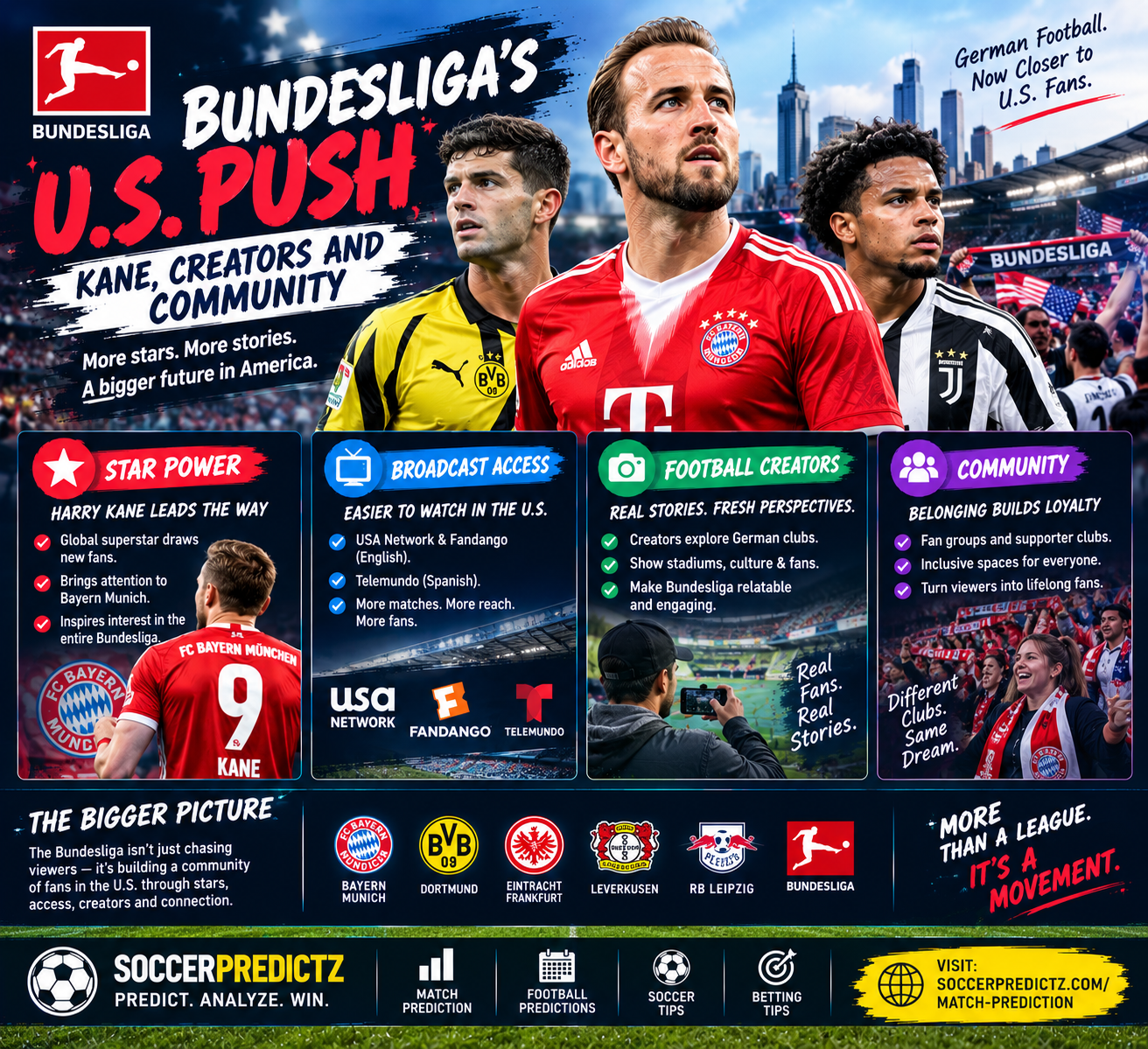
Bundesliga’s Fight for U.S. Fans: Kane, Creators and Community
Introduction: Germany Wants a Bigger Place in American Soccer
The Bundesliga is working to turn growing interest in European football into lasting support across the United States. With Harry Kane leading Bayern Munich’s attack, a new American broadcasting arrangement improving access to matches, and grassroots communities helping supporters connect with German clubs, the league is pursuing a strategy that goes beyond signing famous players.
The opportunity is significant. American audiences have access to more football than ever, but the Bundesliga faces strong competition from the English Premier League, Major League Soccer (MLS), La Liga and other major competitions. Winning attention for a weekend is one challenge; persuading fans to follow an entire season is another.
In its feature, GOAL examines how the Bundesliga is trying to regain its appeal in the United States through star power, creators and community.
The strategy combines several important elements: recognisable players, accessible broadcasts, compelling club stories and welcoming spaces where supporters can share their passion.
For the Bundesliga, the goal is not simply to make Americans recognise Harry Kane. It is to help them discover Bayern Munich, Borussia Dortmund, Bayer Leverkusen, Eintracht Frankfurt and the wider culture of German football.
1. Harry Kane Gives the Bundesliga a Global Superstar
Star players remain one of the easiest ways to introduce a football league to new audiences. Harry Kane is particularly important to the Bundesliga’s American ambitions because he was already widely recognised before joining Bayern Munich.
Kane established his reputation in English football with Tottenham Hotspur and the England national team. His move to Bayern brought one of the world’s most familiar strikers into Germany’s most internationally recognised club.
For American viewers who already follow international tournaments, Kane provides an immediate connection. They may know his name from England’s national team but not realise that they can watch him regularly in the Bundesliga.
That recognition can encourage new viewers to explore Bayern matches. Once they begin watching, they may discover other players, tactical approaches and rivalries that make the competition interesting beyond one superstar.
Kane’s appeal is also connected to his footballing qualities. His finishing, movement, passing and ability to participate in build-up play make him more than a penalty-box striker. He can contribute to attacks in several ways, giving viewers reasons to follow his performances throughout the season.
However, relying entirely on one player would be risky. Players change clubs, miss matches and eventually retire. A sustainable audience needs several reasons to remain interested.
The Bundesliga therefore needs to use Kane’s visibility as an entry point, then introduce fans to the wider competition.
2. Better Broadcasting Access Can Make a Difference
Even the most exciting football league cannot build a large audience if viewers struggle to find its matches.
Broadcast accessibility has been a central issue for international football competitions in the United States. Different subscription services, complicated schedules and unfamiliar club names can create barriers for casual fans.
The Bundesliga’s new U.S. broadcast arrangements aim to make matches easier to access through English-language and Spanish-language coverage.
According to GOAL’s report, the English-language rights arrangement involves USA Network and Fandango, while Telemundo holds Spanish-language rights. The new setup was designed to expand reach and make the competition more accessible to American viewers.
The significance goes beyond the number of games available. Easy access can help fans develop habits. A viewer who discovers a Saturday Bundesliga match may return the following weekend, begin following a particular club and eventually learn about the league’s rivalries.
Spanish-language coverage is also important because the United States has a large Spanish-speaking football audience. Providing coverage in a preferred language can make the competition more welcoming and relevant to different communities.
Broadcasting alone cannot guarantee growth, though. The league must give people compelling reasons to watch once they have found the matches.
That means combining availability with good storytelling, engaging coverage and a consistent presence across digital platforms.
3. The World Cup Can Introduce New Fans to Club Football
International tournaments often bring football to people who do not follow a domestic league every week.
The 2026 FIFA World Cup, hosted by the United States, Canada and Mexico, created an important opportunity for football organisations to reach new audiences. Tournament coverage introduces viewers to national-team stars, memorable goals and international rivalries.
But the transition from a major tournament to regular club football is not automatic.
A viewer may enjoy watching England or another national team without knowing which club its players represent. The Bundesliga’s challenge is to turn that initial curiosity into an ongoing interest in the German game.
Kane offers one clear example. Someone who follows England during international competitions may become interested in seeing him play for Bayern. From there, the viewer can discover Bayern’s opponents, the Bundesliga title race and the distinctive atmosphere of German stadiums.
American players with Bundesliga connections can create another pathway. Their presence gives USMNT supporters a reason to follow particular teams and understand how American footballers develop in Europe.
The league must also recognise that different viewers have different motivations. Some follow elite stars, others enjoy tactical analysis, and many are attracted by club identity, stadium culture and supporter traditions.
A successful strategy provides several entry points rather than assuming every fan wants the same experience.
4. Football Creators Help Tell the Stories Behind the Clubs
Social media creators have become an important part of modern sports coverage. They can explain a club’s history, introduce its players, show supporters what matchday feels like and make unfamiliar competitions easier to understand.
The Bundesliga’s Discover a Club initiative, described in the GOAL feature, is one example of this approach. Creators from the United States and Mexico are invited to spend time with German clubs and tell their stories from a different cultural perspective.
This can be particularly valuable for clubs that receive less international attention than Bayern Munich.
Borussia Dortmund, for example, is known for the atmosphere created by its passionate supporters and the famous Yellow Wall. Eintracht Frankfurt has its own traditions, history and matchday identity. Bayer Leverkusen offers another perspective on modern German football.
A creator who visits a club can show viewers details that a short match highlight may not capture. The experience can include the stadium, local culture, supporter rituals, club facilities and conversations about the team’s identity.
These stories can help potential fans develop an emotional connection before they know every player or understand every tactical detail.
Creators also speak in different styles. Some focus on statistics and tactics, while others specialise in humour, travel, supporter culture or personal experiences.
That diversity can help the Bundesliga reach audiences who might not respond to traditional advertising.
The challenge is to keep the content authentic. Fans are more likely to engage when a story explains what makes a club genuinely distinctive rather than presenting every team as a marketing product.
5. Fan Communities Turn Interest Into Belonging
Broadcasting and digital content can introduce fans to a league, but community can give them a reason to stay.
The GOAL report highlights the Bayern Red Ladies, a supporter group that offers women a space to discuss Bayern Munich and football on their own terms.
The group illustrates a broader point: being a supporter involves more than watching a match. People want places where they can share opinions, discuss tactics, celebrate victories and feel comfortable asking questions.
For international fans, this can be especially important. Someone living thousands of kilometres from Germany may struggle to find friends who support the same club. An organised community can provide a connection that makes following the team more rewarding.
Supporter groups can also help new fans understand the traditions and expectations surrounding a club. They can recommend matches, explain rivalries and introduce people to other supporters.
The Bundesliga benefits when these relationships grow independently of individual marketing campaigns. A fan community that meets regularly, watches matches together or organises online discussions can maintain interest throughout an entire season.
Inclusion matters, too. Supporters should be able to participate regardless of gender, background, experience or level of tactical knowledge.
A welcoming environment expands the potential audience and strengthens the connection between a club and its international supporters.
6. Why the Bundesliga Must Compete With the Premier League and MLS
The Bundesliga does not operate in an empty market.
The Premier League has a powerful international profile, established broadcast relationships and clubs with large global followings. Its English-language presentation can also make it familiar to American viewers.
MLS offers a different advantage: proximity. American supporters can follow local teams, attend matches, meet players at community events and connect with clubs in their own cities.
The Bundesliga must offer a distinctive reason to choose German football alongside these alternatives.
One of its strengths is the matchday atmosphere. German stadiums are often associated with energetic supporter culture, organised chants and strong local identities. These qualities can appeal to fans looking for something beyond the biggest names and most expensive transfers.
The league can also promote its variety of clubs. Bayern’s global profile is valuable, but football in Germany includes teams with different histories, ambitions, styles and communities.
Explaining these differences helps viewers develop preferences. A fan may initially arrive because of Kane but remain because of Dortmund’s atmosphere, Frankfurt’s identity or the story of an emerging player at another club.
The challenge is to communicate those stories consistently and make it simple for viewers to follow the competition week after week.
7. Why American Fans Should Look Beyond the Biggest Stars
Star power attracts attention, but a league becomes more interesting when fans discover the players and teams beyond its headline names.
The Bundesliga has produced and developed many talented footballers, and its clubs provide different sporting environments. Following more than one team can reveal tactical contrasts, changing title races and the challenges faced by clubs with different budgets.
American viewers may also be interested in players with connections to the USMNT. Watching them compete in Germany can help supporters understand their strengths, weaknesses and development over time.
However, individual player form must be considered alongside team tactics, opponent quality and match context. A strong performance in one fixture does not guarantee that the next match will produce the same result.
That principle is useful not only for supporters but also for readers who enjoy football analysis.
8. What the Bundesliga’s U.S. Strategy Means for Match Analysis
The growth of international audiences creates more opportunities for fans to follow fixtures, study team form and compare tactical approaches.
For anyone researching a soccer prediction, the Bundesliga provides a competition with varied playing styles, strong home atmospheres and different levels of team resources.
Reliable soccer predictions should examine recent results, home and away records, injuries, suspensions and the quality of chances created. A famous player can influence a game, but no individual name guarantees a result.
A balanced football prediction should also consider how teams match up tactically. A high-pressing side may struggle against an opponent that can play through pressure, while a team with strong wide attackers may exploit a defence that leaves space on the flanks.
Before making a soccer match prediction, fans should consider whether a team has been consistent over several games rather than relying on one headline result.
Responsible soccer betting tips should explain the evidence behind a selection and acknowledge the uncertainty inherent in football. Past performance is useful context, not a promise of future success.
Practical football tips can include checking confirmed line-ups, reviewing recent defensive performances and assessing whether a team’s results reflect its underlying play.
Readers seeking a broader match prediction can explore upcoming fixtures and analysis on the SoccerPredictz match prediction page.
It is also important to understand soccer odds. Odds reflect market expectations and can change as new information becomes available. They do not guarantee that a particular outcome will happen.
A correct score prediction is especially difficult because it requires forecasting the exact goals scored by both teams. Even a strong tactical analysis may not identify the precise final score.
Fans looking for football predictions today should check the latest team news, availability updates and confirmed line-ups when possible. This approach is more useful than assuming that a famous player or popular club will automatically win.
The same lesson applies to league growth: attention may start with a superstar, but long-term success depends on a deeper understanding of the competition.
Conclusion: Building Fans, Not Just Viewers
The Bundesliga’s push into the United States combines star power, broadcasting access, digital storytelling and supporter communities.
Harry Kane gives new viewers a recognisable face. Improved access makes it easier to watch matches. Creators introduce clubs through engaging stories, while groups such as the Bayern Red Ladies show how football communities can help supporters feel welcome.
The league’s long-term challenge is to convert curiosity into commitment. A successful strategy must give fans reasons to return even when a star is injured, a favourite club loses or the title race becomes less predictable.
That requires consistent coverage, compelling football, accessible broadcasts and genuine connections between clubs and supporters.
The Bundesliga has a distinctive product to offer: passionate stadiums, varied clubs, talented players and traditions that reward deeper exploration.
If it can communicate those strengths effectively, it has an opportunity to build a more durable place in America’s crowded football landscape.
For supporters, the best way to discover German football is to watch the matches, explore different clubs and engage with the communities that make the game special. For SoccerPredictz readers, the same habit of looking beyond headlines helps create more informed football analysis and better understanding of every fixture.
Focus Keywords: soccer prediction, soccer predictions, football prediction, soccer match prediction, soccer betting tips, football tips, match prediction, soccer odds, correct score prediction, football predictions today
– GOAL: How the Bundesliga is carving out a U.S. niche with stars, creators and communities