
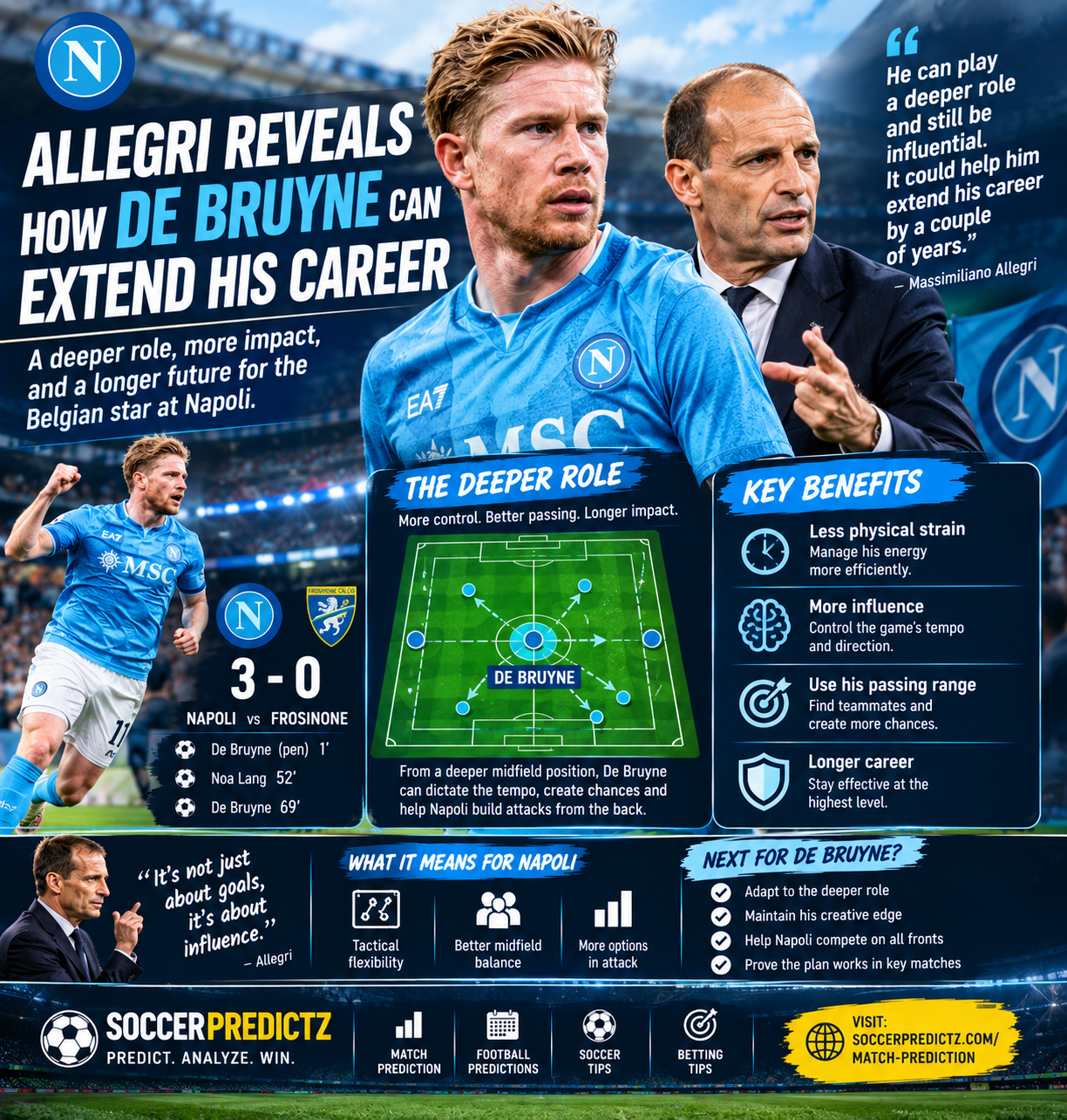
Allegri Reveals How De Bruyne Can Extend His Career
Introduction: Allegri Has a Plan for De Bruyne
Kevin De Bruyne remains one of football’s most gifted playmakers, but even elite players must adapt as they progress through their careers. Napoli manager Massimiliano Allegri believes the Belgian midfielder could enjoy more years at the highest level by making one important tactical adjustment: moving into a deeper midfield position.
The suggestion has sparked an interesting discussion about how experienced footballers can preserve their influence without relying entirely on pace, constant movement and physically demanding attacking runs. Rather than limiting De Bruyne’s creativity, a deeper role could allow him to control matches through his vision, passing range and understanding of the game.
Allegri shared his thinking after Napoli’s 3-0 victory over Frosinone on October 10, 2026. De Bruyne scored twice in the match, reinforcing his importance to Napoli’s attacking plans. The manager believes that using the midfielder as a deeper playmaker could help extend his career by a couple of years.
For football supporters following the latest tactical developments, this is more than an individual player story. It could also influence Napoli’s midfield structure, attacking combinations and future performances. These factors are worth considering when analysing a fixture or preparing a soccer prediction.
What Did Allegri Say About Kevin De Bruyne?
Allegri praised De Bruyne’s performance and suggested that playing as a deeper midfield organiser could help him remain effective for longer. According to the manager’s post-match comments, the Belgian could become even more influential in a playmaking role, although the position is not necessarily his preferred option.
De Bruyne has traditionally been most dangerous when operating closer to the opposition’s penalty area. From advanced midfield positions, he can deliver through balls, create shooting opportunities, combine with forwards and arrive in dangerous areas to score.
However, playing deeper would give him more opportunities to influence the entire game. He could receive possession from defenders, dictate the tempo, switch play across the pitch and launch attacks with accurate long passes.
Allegri’s idea is not necessarily to remove De Bruyne from attacking situations. Instead, it is about managing his responsibilities so that he can contribute consistently without having to make as many physically demanding movements.
The distinction is important. A deeper position could preserve his creativity while allowing Napoli to use his experience and technical ability more efficiently.
Napoli’s 3-0 Victory Over Frosinone
Napoli’s victory over Frosinone provided an encouraging backdrop to Allegri’s comments. The Italian side secured a 3-0 win, with De Bruyne scoring twice and Noa Lang also finding the net.
The match demonstrated De Bruyne’s continued value in decisive moments. His contribution was not limited to creating chances for teammates; he also showed that he could finish opportunities himself.
Napoli started aggressively and created several early opportunities. The breakthrough arrived through a penalty that had to be retaken after the initial attempt was saved. De Bruyne converted the retake to give his team the lead.
Lang subsequently increased Napoli’s advantage, and De Bruyne added another goal late in the match to complete the 3-0 result.
For Allegri, the performance offered positives while also highlighting areas for improvement. Napoli still needed to manage defensive spaces more carefully, particularly when opponents attempted shots from outside the penalty area.
The result nevertheless strengthened the case for building the midfield around De Bruyne’s strengths. His passing, decision-making and ability to influence attacking sequences could become especially valuable as Napoli refine their tactical system.
Why a Deeper Role Could Extend De Bruyne’s Career
1. Better management of physical demands
Modern football places enormous physical demands on midfielders. Players must press opponents, recover defensively, make repeated attacking runs and cover large areas throughout a match.
An advanced attacking midfielder often needs to make explosive movements into the final third, press defenders and quickly transition between attacking and defensive duties.
A deeper playmaker can operate differently. Although the position still requires stamina, tactical awareness and defensive discipline, it can place greater emphasis on positioning, anticipation and passing.
For De Bruyne, a carefully managed deeper role could reduce the need for certain repeated high-intensity movements. It would not eliminate physical demands, but it could help him use his energy more efficiently.
2. Greater influence over the tempo
De Bruyne is renowned for recognising passing opportunities before they become obvious. From a deeper position, he could receive the ball more frequently during the early stages of Napoli’s attacks.
He could then decide whether the team should slow the game down, move possession quickly or exploit space behind the opposition’s defensive line.
This responsibility would make him an important link between defence and attack.
Rather than measuring his influence only through goals and assists, Napoli could benefit from his ability to determine where attacks begin and how quickly the team advances.
3. More opportunities to use his passing range
A deeper position could create more opportunities for De Bruyne to use diagonal passes, switches of play and forward balls between defensive lines.
These passes can force opponents to adjust their shape and create openings for wide attackers or advancing full-backs.
His technical ability could become even more valuable when opponents press Napoli aggressively. If De Bruyne can find the right passing angle under pressure, he may help his team bypass the first line of the press.
4. Experience can replace some physical advantages
As players get older, their physical characteristics may change, but their football intelligence can continue to develop.
Experienced midfielders often improve their understanding of positioning, opposition movements and the timing of passes. They may recognise dangerous situations earlier and avoid unnecessary movements.
De Bruyne already possesses considerable experience at the highest level. A deeper role could allow him to use that knowledge more consistently, rather than depending primarily on repeated runs into attacking positions.
What Could This Mean for Napoli’s Tactical System?
Allegri’s proposal could influence how Napoli organise their midfield and build possession from the back.
When De Bruyne operates closer to the forwards, Napoli have a creative player positioned to deliver the final pass or arrive near the penalty area. Moving him deeper would change where some of that creativity originates.
The defenders could look to De Bruyne as a reliable passing option when progressing the ball. Meanwhile, other midfielders might be asked to make forward runs, cover defensive spaces or provide additional energy around him.
This arrangement would require balance. If De Bruyne drops deeper without adequate protection, opponents could target the space in front of Napoli’s defence. The team would need disciplined positioning from its other midfielders to prevent counterattacks.
Napoli would also have to ensure that their attacking players continue receiving the ball in dangerous areas. A deeper De Bruyne should create more opportunities for teammates rather than simply moving the team’s creative influence farther from goal.
The tactical change is therefore not just about one player. It involves coordinating the entire midfield and making sure every role complements the others.
Could De Bruyne Become a Traditional Playmaker?
Football history offers several examples of technically gifted midfielders adapting their positions as their careers progress. Players who once relied heavily on movement and attacking penetration have sometimes become deeper organisers, using passing and positioning to maintain their influence.
A traditional playmaker generally operates in areas where they can dictate possession and choose the direction of an attack. Such a player must read the game, find space and distribute the ball accurately under pressure.
De Bruyne has many qualities suited to this responsibility. His vision allows him to identify forward passing lanes, while his range of passing helps him reach teammates in different areas of the pitch.
However, a deeper position would also bring new responsibilities. He would need to maintain possession when pressed, recognise when a forward pass is too risky and help Napoli maintain their defensive structure.
The transition would not necessarily happen overnight. Allegri could use the role selectively, depending on the opposition, the availability of teammates and the physical condition of his squad.
A flexible approach might allow De Bruyne to operate deeper during certain phases while still moving forward when Napoli need additional attacking threat.
The Challenges Allegri Must Consider
Although the proposal has clear advantages, it also presents challenges.
First, De Bruyne must be comfortable with the new responsibilities. Allegri acknowledged that the player does not particularly favour moving farther back on the pitch. A successful change will depend on tactical cooperation and the player’s willingness to adapt.
Second, Napoli need to protect the spaces around him. A deep playmaker can be targeted by opponents who press aggressively or attempt to win possession in central areas. The team must provide passing options and defensive cover.
Third, the manager must preserve De Bruyne’s ability to influence the final third. His creativity near goal remains a valuable asset, and moving him deeper should not prevent him from making decisive contributions in attack.
Finally, managing his workload remains important. A positional adjustment cannot guarantee extra years at the top level. Fitness, recovery, injuries, playing time and overall performance will all influence how long he can continue competing at an elite standard.
The idea is best understood as a possible way to improve efficiency and sustainability, rather than a promise about the length of his career.
What This Means for Football Fans and Match Analysis
Tactical changes can influence how teams create chances, defend transitions and control possession. That makes Allegri’s comments relevant to supporters looking beyond the final score.
When assessing Napoli’s upcoming fixtures, fans should watch where De Bruyne receives the ball, how often he drops alongside the deeper midfielders and whether his teammates make forward runs around him.
It is also worth examining whether Napoli become more comfortable playing through an opponent’s press. If De Bruyne can consistently find forwards from deeper areas, the team may develop additional ways to create scoring opportunities.
These observations can support a more informed soccer match prediction, especially when combined with team form, injuries, expected line-ups and the opponent’s tactical approach.
For readers looking for broader soccer predictions, the key is to avoid judging a team solely on its most recent result. Napoli’s 3-0 win was encouraging, but a reliable assessment should consider whether the team can reproduce that performance against different opponents.
Similarly, anyone researching football prediction or football predictions today should distinguish between confirmed team news and tactical possibilities that have not yet become established patterns.
How Tactical News Can Improve Soccer Predictions
A manager’s tactical comments can provide useful context, but they are only one part of a complete match assessment.
Before making a match prediction, consider the following factors:
-
Recent form: Examine performances across several matches instead of relying on one result.
-
Player availability: Injuries and returning players can significantly affect a team’s balance.
-
Tactical matchups: Assess whether the opposition’s pressing style could disrupt Napoli’s build-up.
-
Chance creation: Look at how consistently the team creates quality opportunities.
-
Defensive organisation: Consider whether Napoli can protect the spaces left by an advanced or deeper midfield arrangement.
-
Home and away performance: Playing conditions and venue can influence a team’s approach.
-
Schedule and fatigue: A demanding run of fixtures may affect intensity and player rotation.
These factors are useful when developing a correct score prediction, although exact scores remain particularly difficult to forecast.
Likewise, soccer betting tips, football tips and analysis of soccer odds should be approached with discipline. Odds reflect market expectations, not guaranteed outcomes. No tactical observation can remove the uncertainty inherent in football.
For more football analysis and fixture-focused insights, visit SoccerPredictz Match Prediction.
What Should Fans Watch Next?
The next stage of this story will be whether Allegri consistently uses De Bruyne in a deeper role or treats it as an option for particular matches.
Several signs could indicate that the adjustment is becoming part of Napoli’s wider strategy:
-
De Bruyne regularly receives possession closer to the defensive midfielders.
-
Napoli use him to start attacks rather than relying on him only in advanced areas.
-
Other midfielders make more forward runs to compensate for his deeper position.
-
The team maintains better control of possession against aggressive pressing.
-
De Bruyne remains influential in the final third despite starting attacks from farther back.
If these patterns emerge, Allegri’s idea could become an important feature of Napoli’s tactical development.
The manager will still need to balance creativity with defensive stability. Ultimately, the most effective role will be the one that allows De Bruyne to contribute consistently while serving the team’s overall needs.
Conclusion: A Smarter Role for a World-Class Midfielder
Massimiliano Allegri’s suggestion offers an interesting perspective on how Kevin De Bruyne could prolong his career. By operating as a deeper playmaker, the Belgian could use his exceptional vision, passing range and tactical intelligence while potentially managing the physical demands of his position more efficiently.
Napoli’s 3-0 victory over Frosinone, featuring two goals from De Bruyne, showed that he remains capable of making decisive contributions. The challenge for Allegri is to build a system that preserves those attacking qualities while giving the midfielder greater control over the rhythm of the game.
There is no guarantee that changing positions will extend De Bruyne’s career by a specific number of years. Nevertheless, adapting responsibilities as a player gains experience can be a sensible strategy for maintaining effectiveness.
For Napoli, the potential reward is a midfield that combines De Bruyne’s creativity with improved control and tactical flexibility. For football fans, it is another reminder that the game is not only about speed and physical strength; intelligence, positioning and decision-making can be just as important.
As the season develops, De Bruyne’s role will be worth monitoring. His ability to adapt could prove significant for Napoli—and provide another valuable angle for supporters analysing upcoming matches.
Read the related report from Goal: Allegri reveals key to extending De Bruyne’s career