
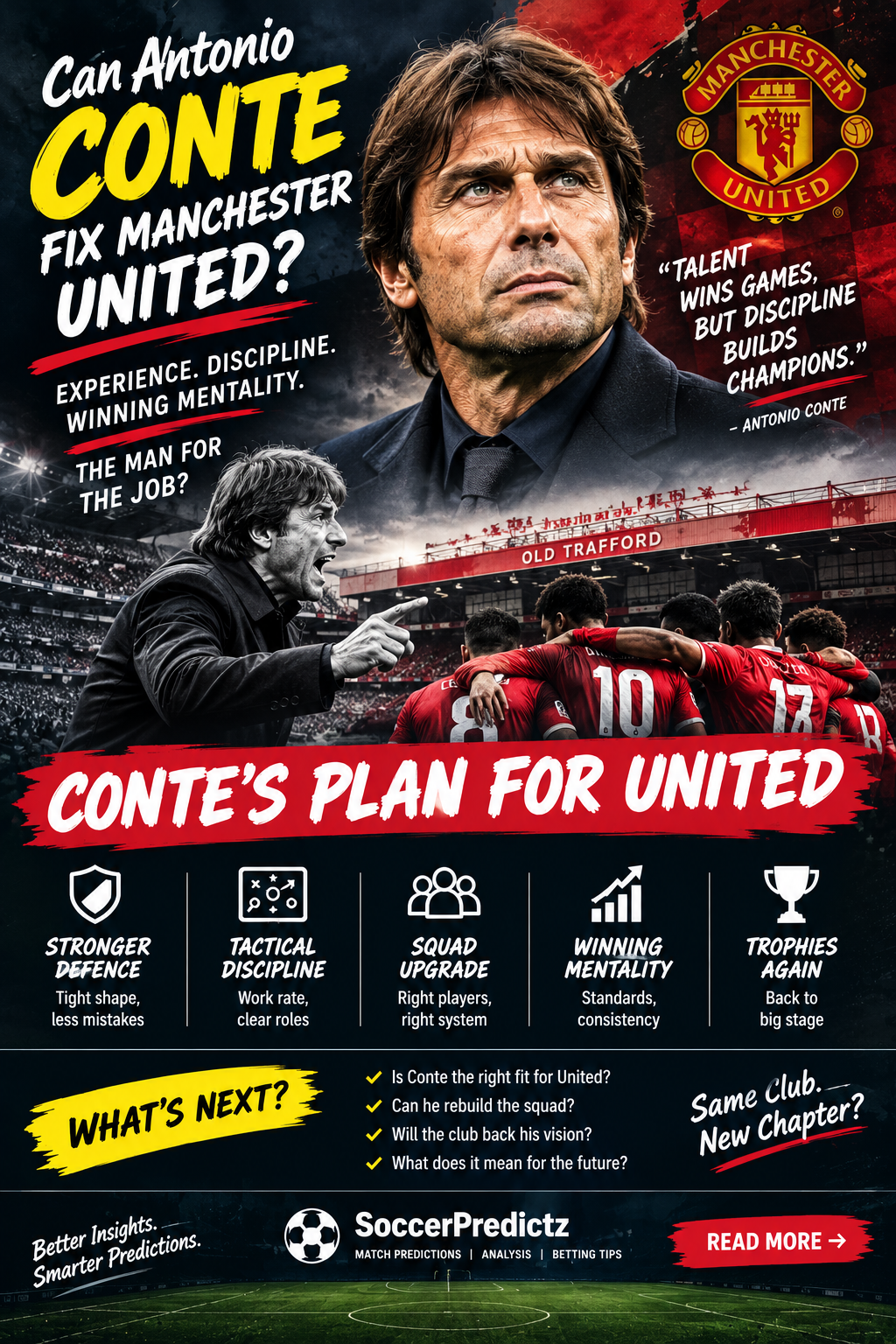
Conte: The Only Coach Who Can Whip Miserable Man Utd Into Shape?
Introduction: Manchester United Need More Than Another Manager
Manchester United are facing another difficult period, with disappointing performances, growing pressure and questions about the team’s tactical identity. For a club with such a proud history, repeated setbacks have created frustration among supporters who expect a serious challenge for major trophies.
Antonio Conte has emerged as one of the names discussed in connection with the managerial position. The Italian coach has built a reputation for demanding standards, tactical organisation and an uncompromising approach to winning. His previous success with Chelsea, Inter Milan and Napoli makes him an intriguing candidate for a club searching for consistency.
But would Conte really be the right person to rebuild Manchester United?
The answer depends on more than his trophy collection. United need a manager who can improve defensive discipline, restore confidence, establish a recognisable playing style and work effectively with the club’s recruitment structure.
It is also important to distinguish speculation from confirmed developments. Conte stated on October 23, 2026, that he was not in advanced negotiations with any club, while Michael Carrick remained Manchester United’s manager as of October 27. Any discussion of Conte taking charge must therefore remain hypothetical.
For football supporters, this situation offers plenty to analyse, from coaching styles and squad weaknesses to future fixtures. It also demonstrates why informed soccer prediction requires looking beyond headlines and considering the wider context surrounding a team.
1. Why Antonio Conte Is Being Linked With Manchester United
Conte is not an ordinary managerial candidate. His career has been built around high expectations, intense training, tactical discipline and a strong demand for accountability.
At Chelsea, he won the Premier League title in his first season, using a well-organised system that allowed the team to defend compactly and attack with speed. At Inter Milan, he helped end Juventus’ long run of domestic dominance by winning Serie A in the 2020–21 season. He later guided Napoli to the Serie A title in 2024–25.
These achievements explain why his name attracts attention whenever a major club needs a reset.
A manager who demands immediate improvement
Conte typically expects his teams to understand their responsibilities clearly. Players must maintain their shape, press with purpose, track opponents and move together when possession changes.
This approach could appeal to United because their problems cannot be solved by attacking talent alone. A team needs coordinated pressing, reliable defensive distances and consistent effort across the pitch.
Conte’s demanding personality can also create urgency. Players who fall below expectations may face difficult conversations, while those who follow the system can benefit from clear roles.
However, this intensity comes with risks. His methods require commitment from the squad and cooperation from club leadership. Manchester United would need to decide whether their football department is prepared to support his approach over the long term.
2. Can Conte Restore Manchester United’s Winning Mentality?
Manchester United’s identity has historically been associated with attacking ambition, resilience and the ability to recover from difficult situations. Recent struggles have increased questions about whether the current squad consistently displays those qualities.
A manager cannot manufacture confidence overnight, but he can establish habits that help a team respond to pressure.
Conte’s teams are generally expected to compete aggressively, defend collectively and treat every phase of the match as important. Those standards could provide a foundation for improvement at Old Trafford.
Discipline must come before results
A winning mentality is not simply about giving motivational speeches. It is built through preparation, accountability and repeated execution.
For United, this could mean reducing unnecessary turnovers, improving defensive transitions, tracking runners more effectively and maintaining concentration late in matches.
The manager would also need to create a competitive training environment in which selection depends on performance and tactical suitability.
However, discipline should not become a substitute for intelligent coaching. Players need to understand why they are being asked to perform certain tasks, and they must have enough confidence to make decisions under pressure.
Conte’s challenge would be to combine strict standards with a positive environment where players can improve rather than simply fear making mistakes.
3. Conte’s Tactical System: Could It Work at Old Trafford?
One of the biggest questions surrounding a possible appointment concerns Conte’s tactical preferences.
He is particularly associated with systems using three central defenders, supported by wing-backs who provide width and contribute to both attacking and defensive phases.
This structure can be highly effective when the squad contains suitable players.
The advantages of a back-three system
A back three can provide extra protection against opposition forwards and allow the team to build attacks through different channels. Wing-backs can push forward, while central midfielders cover space and connect defence with attack.
The system can also help teams create numerical advantages in midfield or wide areas, depending on how the opposition sets up.
For Manchester United, such a change might improve defensive organisation and provide a clearer structure during transitions.
The potential problem
A formation is only as effective as the players executing it. Wing-backs need stamina, tactical awareness and the ability to make repeated runs. Central defenders must communicate effectively, while midfielders need to understand when to press and when to protect space.
If United lack the right personnel for Conte’s preferred structure, the club could face another period of expensive squad rebuilding.
The most sensible approach would be to assess the existing squad before committing to a major tactical overhaul. A successful manager adapts his ideas to the players available while identifying the areas that genuinely need improvement.
For anyone studying football prediction, this tactical question matters because changes in formation can influence goalscoring patterns, defensive stability and the outcome of upcoming fixtures.
4. The Manchester United Squad Needs Clear Responsibilities
Manchester United have invested heavily in players over several seasons, but recruitment spending does not automatically produce a balanced team.
A squad may contain talented attackers and technically gifted midfielders while still lacking the right balance between creativity, defensive security and physical intensity.
Conte would need to identify those gaps quickly.
Defensive organisation
The first priority would be reducing avoidable mistakes. Defenders need clear responsibilities when the team presses high, loses possession or protects a lead.
A compact defensive structure can reduce the space available to opposition attackers and make it easier for midfielders to recover the ball.
Midfield balance
United also need midfielders who can perform complementary roles. Creative players require protection, while defensive midfielders need enough passing ability to help the team progress the ball.
A well-balanced midfield can improve possession, counterattacking opportunities and defensive transitions.
Attacking efficiency
Conte’s teams generally seek to attack with purpose rather than rely on possession for its own sake. United would need to create chances consistently, use their wide players effectively and improve the connection between midfield and the forwards.
The objective should be to build a coherent team rather than focus exclusively on individual stars.
5. Recruitment Could Determine Whether Conte Succeeds
Even an accomplished manager can struggle without appropriate recruitment support.
Conte has historically preferred players who can meet demanding physical and tactical requirements. If Manchester United considered appointing him, the club would need to agree on which positions require reinforcement and how new signings fit the intended system.
Recruitment should not become a cycle in which every new manager requests a completely different group of players.
Instead, United need a long-term football strategy that identifies the club’s preferred style, establishes consistent scouting priorities and gives the manager a balanced squad.
Three priorities for a potential rebuild
First, improve defensive reliability. The team needs defenders who can handle pressure, maintain concentration and defend space effectively.
Second, strengthen midfield control. United need the right mix of ball-winning, progressive passing and creativity to manage different types of opponents.
Third, recruit for tactical suitability. A player’s reputation should not outweigh their ability to perform the role required by the manager.
These principles are useful well beyond Manchester United. When evaluating a team’s prospects, supporters should examine whether the squad suits its tactics rather than assuming that a famous manager or expensive signing will guarantee success.
6. Would Conte’s Personality Fit Manchester United?
Conte’s intensity is one of his greatest strengths, but it can also create challenges.
He is known for demanding significant commitment from players and club leadership. His approach can produce impressive short-term improvements, but disagreements over recruitment, expectations and the direction of a project have also been features of his managerial career.
Manchester United would therefore need more than a coaching appointment. The club would need a clear agreement about responsibilities, transfer decisions and long-term objectives.
The importance of alignment
A manager should have enough authority to implement a footballing philosophy, while the club must retain a consistent recruitment and financial strategy.
If these priorities conflict, even strong results may not provide lasting stability.
United’s leadership would need to establish realistic targets, communicate clearly with supporters and give the coaching staff the resources necessary to improve the squad.
Conte could potentially bring energy and structure, but he would not eliminate the need for sound decision-making at executive level.
7. What Would Success Look Like Under Conte?
If Manchester United ever appointed Conte, success should be measured through a series of achievable improvements rather than promises of instant glory.
Short-term goals
The first objective would be making the team more difficult to beat. Better defensive organisation, improved work rate and fewer individual errors could help United become more competitive.
The team would also need to demonstrate a clearer attacking plan, particularly against opponents who defend deep.
Medium-term goals
Over the following months, United would need to show consistency against both strong and less-fancied opponents. They should become more effective at controlling matches, protecting leads and recovering after conceding.
Progress in these areas would provide a stronger foundation for pursuing European qualification and competing for domestic honours.
Long-term goals
The ultimate test would be whether United could sustain success over several seasons. That would require effective recruitment, player development, financial discipline and a stable relationship between the manager and club leadership.
Conte’s record suggests that he can deliver major improvements, but no coach can guarantee that every appointment will succeed.
The quality of the squad, the level of support from executives and the willingness of players to embrace a new system would all influence the outcome.
8. What the Conte Debate Means for Soccer Prediction
Managerial uncertainty can make football analysis more complicated. Rumours about a possible appointment may affect expectations, but predictions should be based on confirmed information rather than speculation.
As of October 27, 2026, Carrick remained in charge at Manchester United, and Conte had denied being in advanced negotiations. That distinction is essential when analysing the team’s next matches.
For reliable soccer predictions, consider the following factors:
-
Confirmed team news: Check injuries, suspensions and expected lineups.
-
Recent form: Assess results and performances over several games.
-
Tactical approach: Consider formations, pressing intensity and defensive organisation.
-
Managerial developments: Distinguish official announcements from media speculation.
-
Opponent strength: Evaluate the quality and style of the team United are facing.
-
Home and away performance: Consider whether the fixture is at Old Trafford or away from home.
These details can support a more informed soccer match prediction than simply assuming a change of manager will transform the team immediately.
Fans considering soccer betting tips should also remember that managerial rumours do not guarantee a particular result. Changes in tactics can take time, and soccer odds may already reflect market expectations.
A responsible correct score prediction is especially difficult because the exact result depends on finishing, defensive errors, injuries and other unpredictable events.
For upcoming fixtures, readers can explore the SoccerPredictz match prediction section for further match analysis and football insights.
The same principles apply to football prediction, football tips, soccer predictions and football predictions today: use current evidence, assess the full context and avoid treating any outcome as certain.
Conclusion: Conte Could Bring Structure, but United Need a Complete Plan
Antonio Conte has the experience, tactical discipline and winning record to make him an interesting candidate for Manchester United. His previous success demonstrates that he can organise teams, improve standards and compete for major trophies.
Yet the idea that he is the only coach capable of fixing United is too simplistic. The club’s problems involve recruitment, tactical identity, player confidence and long-term leadership as well as the manager on the touchline.
Conte could offer a demanding reset if the club and coach shared the same vision. But his success would depend on the suitability of the squad, support from the football department and a willingness to build a coherent project.
For now, his potential appointment remains speculation, and Michael Carrick remains in charge as of October 27, 2026.
Manchester United’s immediate task is to improve performances and restore consistency. Whoever leads the club in the future will need to deliver more than a short burst of enthusiasm: United need a clear plan, better execution and sustained progress.
Follow SoccerPredictz for football analysis, match previews and informed perspectives on the stories shaping the game.
For further context on the possible candidates and the challenges facing Manchester United, read The Guardian’s analysis of potential successors to Michael Carrick