
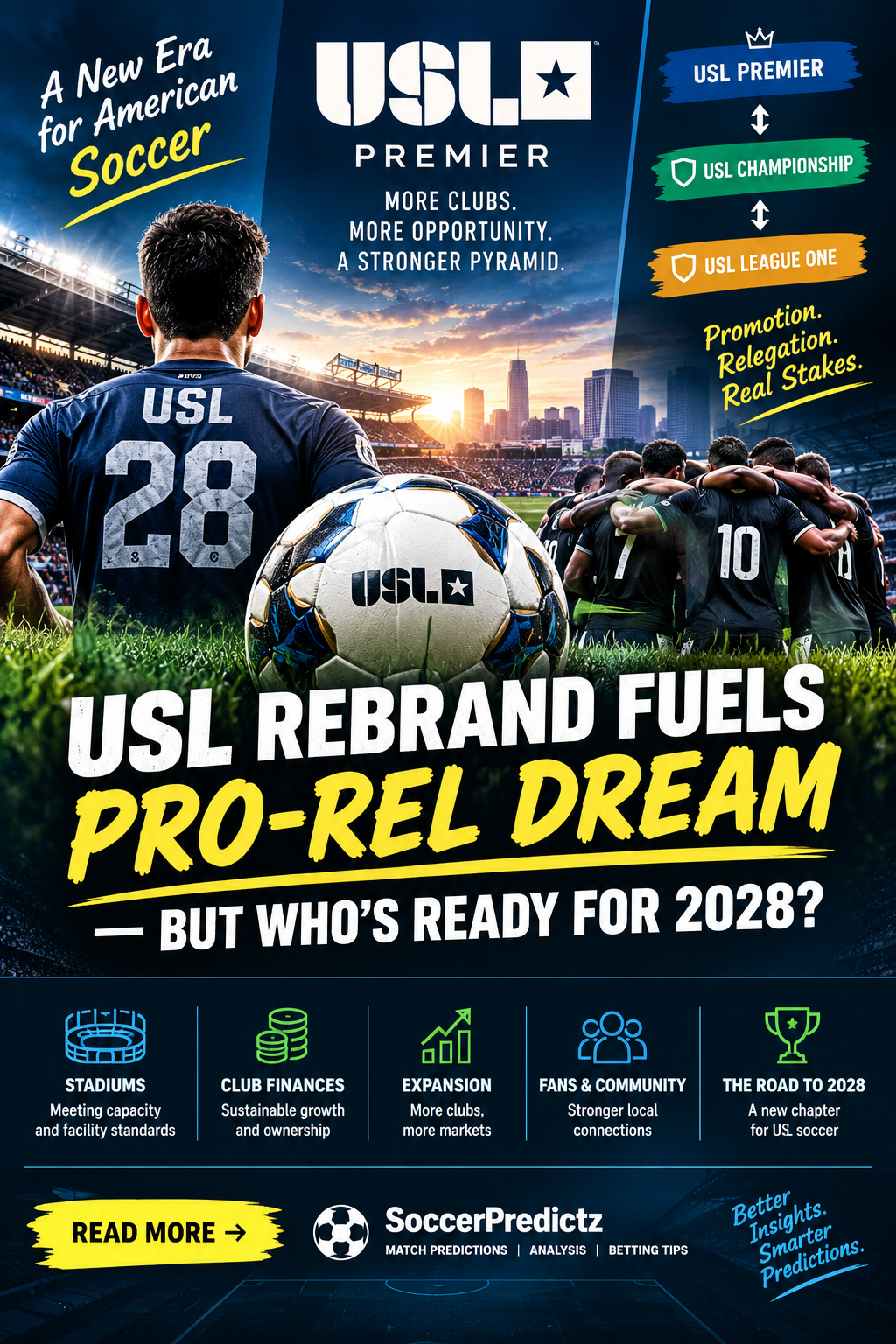
USL Promotion and Relegation: Who’s Ready for 2028?
Introduction: American Soccer Is Preparing for a Major Change
American professional soccer could be approaching one of the biggest structural changes in its history. The United Soccer League (USL) is preparing to introduce a connected three-tier men’s professional system featuring promotion and relegation, bringing a familiar global football concept into a different American sporting environment.
The league’s latest rebrand has made that ambition more tangible. Its proposed top division, USL Premier, is targeting a 2028 launch, with the USL Championship and USL League One forming the lower levels of the planned structure. Clubs would have a pathway to move between divisions according to sporting performance, rather than remaining permanently within a closed league structure. <Cite refs={[“turn854606search0″,”turn854606search4”]} />
For supporters, the prospect is exciting. Promotion battles could give ambitious clubs a route towards the highest level, while relegation pressure could make the final weeks of a season more meaningful. Smaller markets might also gain a clearer long-term target for professional growth.
However, announcing a new identity and a competition model is only the beginning. Stadium capacity, financial sustainability, ownership standards, expansion and league approval all need careful attention before the proposed system can operate.
The key question is no longer simply whether promotion and relegation sounds attractive. It is whether enough clubs are genuinely ready to make it work by 2028.
For readers following American soccer and upcoming fixtures, SoccerPredictz Match Prediction offers a destination for football previews and match analysis.
1. What Is the USL Rebrand Trying to Achieve?
The USL’s rebrand is about more than a new logo or visual identity. It represents an attempt to present a clearer structure for the future of professional soccer in the United States.
The proposed men’s pyramid consists of three connected levels:
- USL Premier: The planned Division One competition, targeted for 2028.
- USL Championship: The existing second-tier professional competition.
- USL League One: The third-tier competition, with scope for continued national growth through regional organisation.
The long-term framework envisions USL Premier and the Championship operating as national competitions, while League One can continue developing through a more regional structure. The precise competition arrangements and movement between divisions will depend on the final rules and implementation.
The goal is to establish a more connected pathway for clubs, players and communities. Instead of a team reaching a particular level and finding its long-term ambitions restricted by the structure, sporting success could eventually create an opportunity to move higher.
That would also give club owners a clearer story to present to sponsors, supporters and local authorities. A club could explain how its facilities, recruitment and community investment support a long-term sporting ambition.
Yet the new structure must be credible. Fans need to understand the rules, clubs need realistic financial plans, and the league must ensure that promotion does not place a successful team in an unsustainable position.
2. Why Promotion and Relegation Matters to American Fans
Promotion and relegation is familiar to football supporters around the world. In many European and South American leagues, teams move between divisions based on their finishing positions, creating sporting consequences at both ends of the table.
The USL wants to introduce that principle into its professional men’s structure. The biggest attraction is competitive jeopardy: clubs competing for promotion would have more to play for, while those near the bottom could face the threat of dropping into a lower division.
This can create compelling stories throughout a season. A club outside the championship race might still be fighting to avoid relegation, while a team that begins the campaign slowly could build momentum and challenge for promotion later.
For supporters, these stakes can strengthen the connection between the team and the community. Matches matter not only because of rivalries or individual performances, but also because the result may influence the club’s future division.
Promotion and relegation can also provide a sporting pathway for ambitious teams in smaller cities. A well-run club with strong support and effective recruitment could potentially rise through the system.
However, the model is not a guaranteed solution to every problem. Relegation can create financial pressure, while promotion can require investment in player wages, travel, staffing and facilities. The USL will need rules that make sporting movement possible without exposing clubs to avoidable financial danger.
3. USL Premier: The Challenge of Launching by 2028
USL Premier is intended to become the top division within the new USL men’s structure. The league has outlined a long-term ambition for a national competition of around 20 clubs, but reaching that scale requires careful expansion and preparation.
The first task is identifying clubs capable of meeting the relevant sporting, financial and operational standards. Potential participants need more than a strong team. They must demonstrate that their ownership, stadium, staffing, commercial operations and long-term plans are suitable for top-level professional competition.
USL officials have discussed a launch target of 2028, and the league has been working to identify prospective members. Yet the final inaugural lineup should not be treated as settled until clubs and the relevant authorities confirm their positions. <Cite refs={[“turn854606search0″,”turn854606search3”]} />
A successful launch would need enough teams to create a credible national competition. Too few clubs could limit geographic reach and competitive variety, while expanding too quickly could put pressure on finances and infrastructure.
The challenge is to balance ambition with readiness. A strong inaugural league would establish confidence among supporters, sponsors, broadcasters and potential investors. A rushed launch, by contrast, could undermine the long-term project before it has fully developed.
4. Stadiums Could Decide Which Clubs Are Ready
One of the most significant obstacles is stadium infrastructure. Under the current U.S. Soccer professional league standards discussed in reporting about USL Premier, Division One clubs face requirements relating to venue capacity, ownership and market size.
A minimum seating capacity of 15,000 has been a particularly important issue. Some established clubs have strong attendance and community support but may not have stadiums that meet the current requirements.
Pittsburgh Riverhounds, for example, have discussed plans to expand their stadium to a capacity of 15,000. Other clubs have invested in or planned new venues as they consider their long-term ambitions. Such projects can require substantial funding, permits, construction work and coordination with local stakeholders. <Cite refs={[“turn854606search1″,”turn854606search3”]} />
Stadium development is not simply a matter of adding seats. Clubs need suitable facilities for players, officials, supporters, media and commercial partners. They must also consider transport access, safety, maintenance costs and the match-day experience.
For some organisations, building or expanding a stadium could create valuable long-term assets. For others, the cost may be difficult to justify unless demand and revenue can support it.
This creates a difficult question for the USL: how can the league establish credible top-division standards while allowing ambitious community clubs to grow at a sustainable pace?
5. Which Clubs Could Be Ready for the Next Step?
The clubs best positioned for USL Premier will likely be those combining sporting ambition with reliable ownership, strong local support and a realistic infrastructure plan.
Sacramento Republic and Detroit City are among the clubs that have attracted attention in discussions about future ambitions and stadium development. Pittsburgh Riverhounds have also been associated with stadium expansion plans. However, stadium projects and public interest should not be interpreted as automatic confirmation that a club will join USL Premier.
The USL is expected to evaluate prospective participants according to the applicable standards and the requirements of the new competition. The inaugural membership will depend on formal decisions and the readiness of individual organisations.
Meanwhile, teams in the USL Championship and League One will have to consider whether moving up is the right decision for their business. Promotion can bring new opportunities, but it may also mean higher operating costs, stronger opposition and additional pressure on recruitment.
The most prepared clubs will not necessarily be the ones making the loudest announcements. They will be those able to demonstrate that their stadium, ownership, commercial model and sporting plans can support the next level over multiple seasons.
6. Financial Sustainability Is Just as Important as Ambition
Promotion and relegation creates a sporting pathway, but the financial consequences need careful management.
A promoted club may need to increase player wages, recruit more staff, improve training facilities and expand its travel budget. Those expenses can rise before the club has secured additional sponsorship or media revenue.
Relegation creates the opposite problem. A team dropping into a lower division may lose some commercial opportunities or face reduced income while still carrying contracts and operating costs established at the higher level.
This is why sustainable budgeting matters. Clubs need to understand how they would operate under different sporting outcomes rather than building plans around the assumption that promotion will happen and last indefinitely.
The USL has also been laying groundwork for revenue sharing and a more connected commercial structure. Such arrangements could help clubs participate in league-wide opportunities, although their effectiveness will depend on the revenue generated and the final terms.
Strong governance will be essential. Clear financial reporting, realistic ownership commitments and prudent spending can help reduce the risk of clubs failing when circumstances change.
The long-term success of the new system will depend on whether it can reward sporting achievement while keeping clubs financially viable.
7. How the USL Could Change the Wider American Soccer Landscape
USL Premier would enter a market where Major League Soccer already occupies the established Division One position. The proposed USL structure is not an automatic merger with MLS, and the introduction of promotion and relegation within the USL would not mean MLS clubs could be relegated through that system.
Instead, USL is developing its own interconnected pathway. That could offer a different model of professional soccer, with clubs able to pursue progression within the organisation’s three-tier structure.
The approach may appeal to fans who want more sporting consequences throughout the season. It could also attract investors interested in building clubs around local identity and long-term development.
Still, the USL must prove that the new structure can attract audiences, sponsorship and media attention at a level that supports its ambitions. Competition with established leagues requires a compelling product, not just a different format.
The opportunity is significant, but the result will depend on execution. Supporters need good matches, accessible venues, clear club identities and confidence that their teams are being managed responsibly.
8. What the Change Means for Players and Supporters
A connected pyramid could create more pathways for players. Clubs operating at different levels would have clearer sporting objectives, and strong performances could help players earn opportunities with teams competing in higher divisions.
Promotion battles could also affect recruitment. Ambitious clubs might seek experienced players capable of delivering results immediately, while others could focus on youth development and long-term squad building.
For supporters, the change could make the league table more meaningful. A late-season match between clubs fighting for promotion or trying to avoid relegation could carry major consequences for both teams.
Community identity will remain central. A promotion and relegation model cannot succeed on competitive structure alone; clubs need relationships with local supporters, youth programmes, sponsors and civic organisations.
If the USL gets these elements right, the new system could strengthen local rivalries and give fans a more direct connection to their club’s future.
9. What Football Fans Should Watch Before the 2028 Launch
As preparations continue, supporters should follow several key developments:
- Confirmed founding clubs: Which organisations formally commit to the new top division?
- Stadium progress: Are prospective members completing the facilities needed to meet applicable standards?
- Final league rules: How will promotion, relegation, playoffs and divisional movement work?
- Financial safeguards: What measures will help clubs manage the cost of promotion and the risk of relegation?
- Commercial growth: Can the league build sustainable sponsorship, broadcast and match-day revenue?
- Community support: Are clubs developing the local relationships needed to attract fans consistently?
These developments will reveal more about the project’s readiness than branding alone. A new logo can communicate ambition, but reliable infrastructure and clear regulations will determine whether the system works in practice.
For readers following results and upcoming fixtures, the same attention to evidence applies to football analysis. A useful soccer prediction should consider form, injuries, team selection and tactical matchups. Reliable soccer predictions should explain their reasoning, while a balanced football prediction should acknowledge uncertainty.
A detailed soccer match prediction can assess home advantage and recent performances. Readers exploring soccer betting tips should understand that no outcome is guaranteed, and practical football tips should focus on evidence rather than hype.
Likewise, every match prediction involves uncertainty, and soccer odds represent market prices rather than guarantees. A correct score prediction is particularly difficult because it requires forecasting the exact goals scored by both teams. For football predictions today, current team news and verified information are more useful than assumptions.
Explore more fixture previews and football analysis at SoccerPredictz Match Prediction.
Conclusion: The Rebrand Is a Beginning, Not the Finish Line
The USL’s rebrand has given its promotion and relegation ambition a clearer identity. With USL Premier targeting a 2028 launch, American soccer has an opportunity to develop a more connected professional pathway and create meaningful sporting consequences across multiple divisions.
But the real test lies ahead. Stadium requirements, ownership standards, club finances, expansion and the final competition rules must all align before the project can operate successfully.
The clubs most ready for 2028 will be those that combine sporting ambition with sustainable management. They will need reliable facilities, committed ownership, strong community support and realistic plans for both success and setbacks.
For supporters, the prospect is exciting. A successful promotion and relegation system could give more clubs a route towards the top and make more matches matter throughout the season.
The USL has made its ambition clear. Now it must turn that vision into a durable competition that serves clubs, players and fans for years to come.
Related external reading: United Soccer League — USL Premier and the new interconnected men’s professional structure