
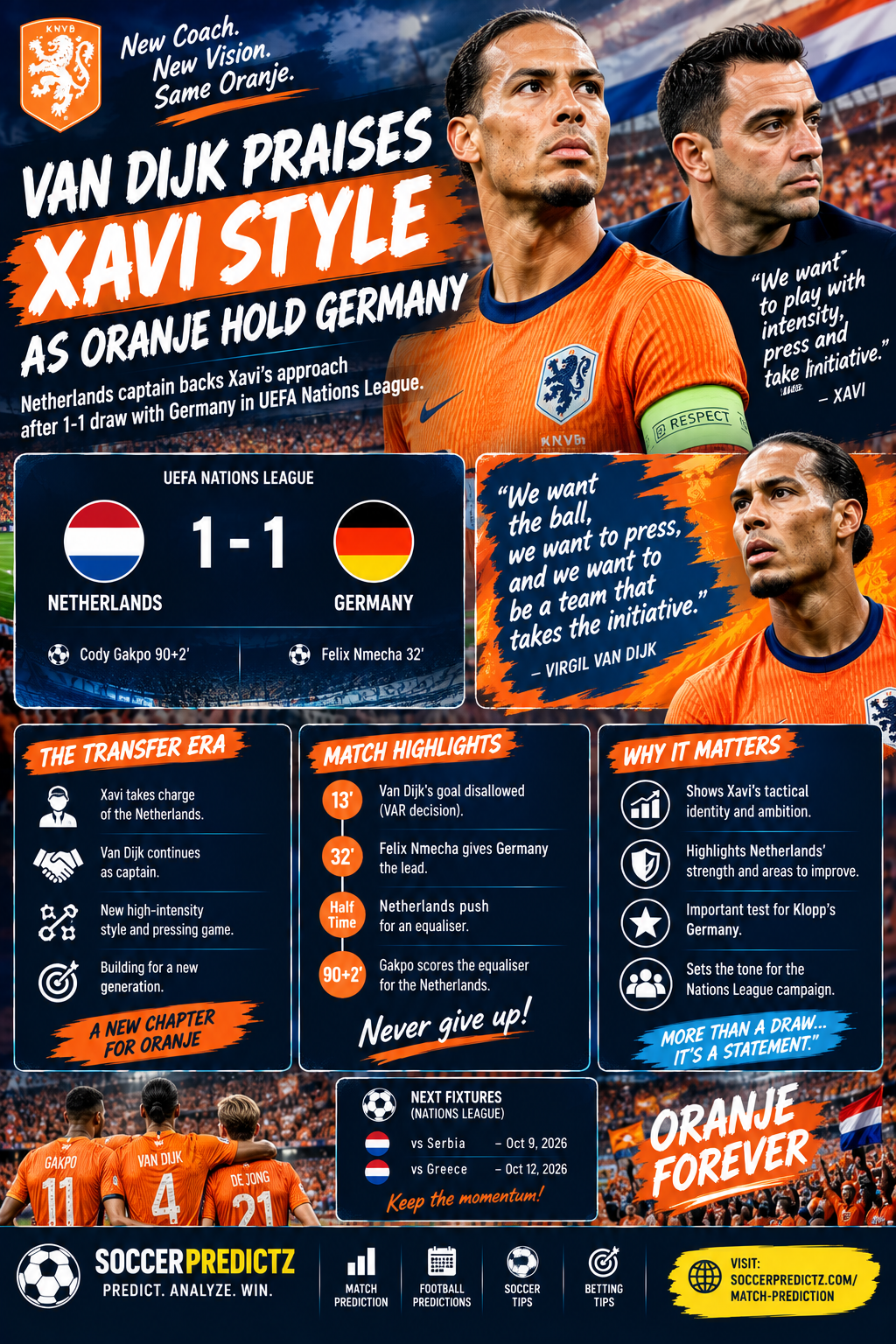
Van Dijk Praises Xavi Style as Oranje Hold Germany
The Netherlands began the Xavi Hernández era with a dramatic 1-1 draw against Germany in the UEFA Nations League, and captain Virgil van Dijk has already praised the tactical direction introduced by the new manager.
Cody Gakpo’s stoppage-time equaliser rescued a point for the Oranje after Germany had taken the lead through Felix Nmecha. The match also featured a disallowed early goal from Van Dijk, several chances for the Netherlands and an encouraging second-half performance from Xavi’s side.
The result was significant for both teams. Xavi was taking charge of the Netherlands for the first time, while Jürgen Klopp was beginning his competitive tenure as Germany head coach.
For supporters following soccer prediction news, the match offered plenty to analyse. The Netherlands showed signs of a more aggressive tactical identity, while Germany demonstrated the attacking potential and defensive vulnerabilities that could define Klopp’s first international cycle.
Xavi’s Netherlands Begin With a New Identity
Xavi was appointed Netherlands head coach after the team’s disappointing 2026 World Cup campaign and Ronald Koeman’s subsequent departure.
Before the Germany match, Xavi had already explained that he wanted his team to play with intensity, passion and initiative. He also emphasised the importance of pressing and creating a positive team culture.
Those ideas were visible against Germany.
The Netherlands attempted to press higher up the pitch and looked to regain possession quickly after losing the ball. The team also tried to maintain pressure through sustained possession rather than relying exclusively on counter-attacks.
Van Dijk recognised the tactical change after the game.
The Netherlands captain said that having the ball and pressing were important parts of the team’s approach, while acknowledging that there was still room for improvement.
That assessment is understandable. Xavi had only recently begun working with the players, meaning the team had limited time to absorb his tactical instructions.
For anyone analysing future soccer predictions, the development of this system will be one of the most interesting aspects of the Netherlands’ Nations League campaign.
Van Dijk Backs the New Approach
Van Dijk’s comments are particularly important because he remains central to Xavi’s plans.
The former Barcelona midfielder confirmed before the match that Van Dijk would continue as Netherlands captain after discussions between the two men.
That meeting was significant for the Dutch national team. Van Dijk had been considering his international future following the World Cup, but Xavi wanted the experienced Liverpool defender to continue leading the squad.
The manager described Van Dijk as positive, motivated and capable of remaining an important leader.
Van Dijk then responded on the pitch with a commanding performance against Germany, despite having an early goal ruled out.
His support for Xavi’s philosophy could help the new coach establish authority within the squad.
Leadership is particularly important during a managerial transition. Players need to understand the tactical instructions while also maintaining confidence in a new system.
Netherlands Thought They Had Taken the Lead
The Netherlands appeared to have made the perfect start when Van Dijk headed home from a corner in the 13th minute.
However, the goal was later disallowed following a VAR review.
The referee determined that Brian Brobbey had obstructed Germany goalkeeper Marc-André ter Stegen before Van Dijk made contact with the ball.
The decision frustrated the Netherlands and their captain.
It was a major moment because an early goal would have given Xavi’s team an ideal start and potentially forced Germany to change its approach.
Instead, the match remained level until Germany eventually found the breakthrough.
The incident also demonstrated how important set pieces could become for Xavi’s Netherlands. Van Dijk remains a significant aerial threat, while the team’s technical quality provides opportunities to create different types of attacking routines.
Felix Nmecha Gives Germany the Lead
Germany eventually took control of the scoreboard in the 32nd minute.
Philipp Treu delivered the ball across the penalty area, and Felix Nmecha finished from close range to score the first goal of Klopp’s Germany era.
The goal was important for a Germany team beginning another new chapter.
Klopp was appointed after Germany’s early elimination from the 2026 World Cup. His first competitive match therefore carried considerable attention, particularly because the opposition was the Netherlands.
Germany showed moments of quick attacking play but also struggled to maintain control for long periods.
The visitors had opportunities to extend their advantage before half-time, with Karim Adeyemi missing a chance from close range.
That miss eventually became more significant.
Xavi Changes the Momentum After Half-Time
The Netherlands were much more aggressive after the interval.
Xavi’s team pushed Germany deeper and began creating more opportunities around the penalty area.
The Dutch press became more effective, while the midfield increased its intensity.
The Netherlands also began finding more space in wide areas, allowing players to deliver balls into the box.
Germany goalkeeper ter Stegen became increasingly important.
He made several saves to keep his team ahead, including a crucial stop after Denzel Dumfries broke into the penalty area.
The Netherlands continued pressing and eventually produced enough pressure to force the equaliser.
For Xavi, the second half offered encouraging evidence that his tactical ideas can work at international level.
The execution was not perfect, but the team demonstrated the willingness to press, attack and take initiative that the coach had promised before the match.
Cody Gakpo Rescues the Netherlands
Germany appeared close to securing victory until the final moments.
Then Cody Gakpo changed the game.
The Liverpool forward produced a stoppage-time volley to make it 1-1, finishing a swift attacking move involving Ruben van Bommel.
The goal came in the 92nd minute and sparked celebrations inside the Johan Cruyff Arena.
It was a deserved reward for the Netherlands’ second-half pressure.
Germany had defended its lead for almost an entire half, but the constant pressure eventually produced an opening.
Gakpo’s goal also prevented Klopp from beginning his Germany tenure with a victory.
For Xavi, the late equaliser provided an important psychological boost.
The Netherlands had fallen behind but continued pushing until the final whistle.
Van Dijk Sees Room for Improvement
Despite the positive result, Van Dijk did not suggest that the Netherlands had completed the tactical transition.
Instead, he acknowledged that the team remains a work in progress.
The captain pointed out that the Netherlands could still improve their pressing and admitted there were moments when the team looked vulnerable.
That honesty is valuable.
A new tactical system cannot be perfected in a few training sessions. International coaches have particularly little time with their squads compared with club managers.
Xavi therefore needs to develop his principles gradually.
The Germany match provided the first competitive test.
The Netherlands demonstrated intensity and attacking ambition, but there were also defensive gaps and moments when the press was not coordinated.
These are exactly the areas that Xavi will need to address.
A Different Netherlands Under Xavi
One of the biggest questions surrounding Xavi’s appointment was whether he could create a clear identity for the Netherlands.
The early evidence suggests he wants a team that takes initiative.
Rather than waiting for opponents to make mistakes, the Netherlands are being encouraged to actively force those mistakes.
High pressing is central to that philosophy.
The front players must close passing lanes, midfielders have to move aggressively and the defence must maintain a high enough position to keep the team compact.
Van Dijk’s role is therefore particularly important.
As the last line of defence, he must judge when to step forward and when to protect space behind the press.
His experience allows him to make those decisions, but the entire team must move together for the system to work.
The Importance of Van Dijk’s Leadership
Van Dijk’s decision to continue with the Netherlands gives Xavi an experienced leader during a period of transition.
Memphis Depay was left out of Xavi’s first squad, creating another significant change in the national team hierarchy.
Depay is the Netherlands’ record goalscorer, but Xavi decided to move in a different direction for his first international window.
That makes Van Dijk’s leadership even more important.
The Liverpool defender understands the expectations surrounding the national team and has experienced several international tournaments.
His relationship with younger players can also help Xavi communicate his ideas.
For football prediction analysis, leadership is sometimes overlooked because it does not appear directly in statistical models. However, the influence of an experienced captain can become particularly important during tactical and personnel changes.
What the Draw Means for Germany
For Klopp, the 1-1 draw was a mixed beginning.
Germany produced enough attacking opportunities to win the match but failed to protect its lead.
Nmecha’s goal gave the visitors an advantage, while Adeyemi also had opportunities.
However, the Netherlands’ increasing pressure exposed weaknesses.
The late equaliser means Klopp will have to address Germany’s defensive structure before the next Nations League fixtures.
The German manager has inherited a squad with considerable technical quality, but establishing the right balance between pressing, possession and defensive security will take time.
The Netherlands match was therefore an important first test rather than a definitive assessment of Klopp’s tenure.
What the Result Means for Future Soccer Analysis
For anyone searching for soccer betting tips, the Netherlands’ performance provides several useful indicators.
The team is likely to be more aggressive under Xavi, which could create both attacking opportunities and defensive risks.
A high press can lead to quick chances when executed correctly, but it can also leave space behind the defensive line if the first wave of pressure is beaten.
That balance will be particularly important against teams capable of playing through pressure.
The same principle applies to soccer odds.
Market expectations can change as a new manager’s style becomes clearer, but analysts should avoid making conclusions based on one match alone.
The 1-1 draw against Germany showed promise, but Xavi’s tactical project is still in its early stages.
What to Watch in the Next Matches
The Netherlands’ next Nations League fixtures will provide further evidence of Xavi’s tactical direction.
The Dutch are scheduled to face Serbia and Greece during this international window.
Those matches will allow Xavi to test different combinations and continue developing his pressing structure.
Midfielder Joey Veerman was singled out positively by Xavi after the Germany match, while Quinten Timber was also praised for providing a different profile.
That suggests midfield selection could become an important part of the new system.
Xavi has already indicated that he values players who can retain possession and understand the game, while also appreciating midfielders who can win physical duels.
This tactical flexibility could become one of the defining features of his Netherlands team.
What It Means for Soccer Prediction Fans
The Netherlands are entering a new era, making them particularly interesting for soccer match prediction analysis.
The core of the team remains experienced, with Van Dijk continuing as captain, but Xavi is also introducing new ideas and evaluating different players.
That combination creates uncertainty in the short term.
For football tips, the Netherlands should be assessed based on their confirmed line-up, tactical setup and opponent rather than reputation alone.
The same applies to match prediction models.
A team undergoing a tactical transition can behave differently from the side that played under its previous manager.
For fans looking at correct score prediction, the Netherlands’ new high-intensity approach could produce matches with greater attacking momentum, although defensive vulnerabilities remain something to monitor.
And for those following football predictions today, the main story is clear: Xavi has begun his Netherlands tenure with an encouraging draw, but the real test will be whether the tactical ideas become consistent over the coming matches.
Final Thoughts
Virgil van Dijk’s positive assessment of Xavi’s approach is an encouraging sign for the Netherlands.
The 1-1 draw with Germany was far from perfect, but it demonstrated several characteristics that Xavi wants from his team: intensity, pressing, possession and a willingness to take the initiative.
Germany led through Felix Nmecha, but the Netherlands responded strongly after half-time before Cody Gakpo’s 92nd-minute volley secured a point.
Van Dijk’s disallowed early header was another major talking point, while his continued role as captain gives Xavi an experienced leader to help guide the transition.
The new Netherlands manager now has the opportunity to refine his system and introduce more consistency.
For supporters, the most encouraging aspect may be that the team continued attacking even after falling behind.
Xavi’s era has started with a draw, but the performance has already provided plenty of clues about what the Oranje could become.
The next matches against Serbia and Greece will reveal whether the intensity and tactical identity shown against Germany can be maintained.
For anyone following soccer predictions, the Netherlands are now a team worth watching closely as Xavi begins building his version of the Oranje.
Internal link: SoccerPredictz Match Prediction
Related external post: Goal — Van Dijk praises Xavi style as Oranje hold Germany