
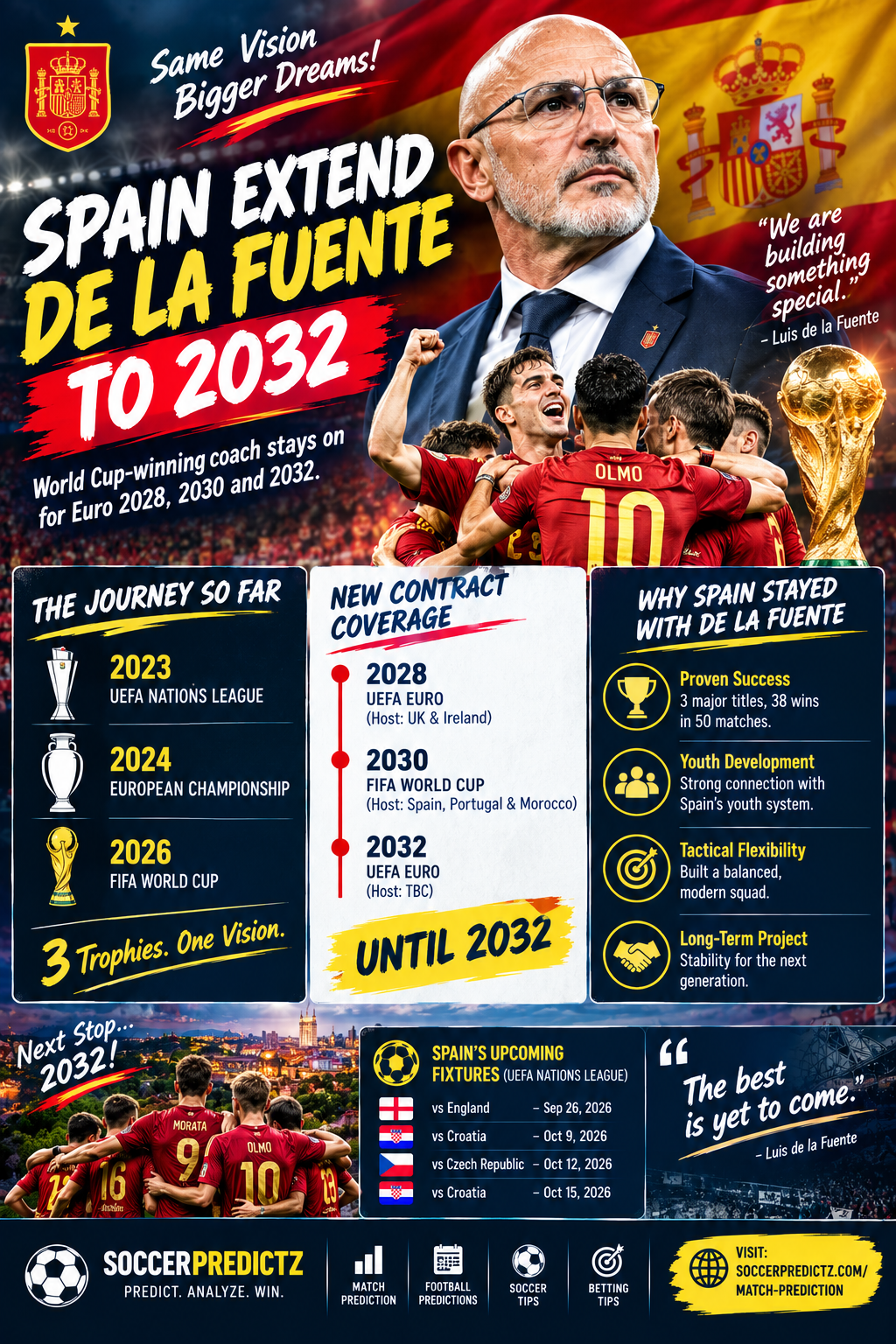
Spain Extend De la Fuente Contract Through 2032
Spain have secured the long-term future of Luis de la Fuente, with the Royal Spanish Football Federation approving a contract extension that will keep the World Cup-winning coach in charge of the national team until 2032.
The decision follows one of the most successful periods in Spain’s recent football history. Since taking charge of the senior side, De la Fuente has guided La Roja to the 2023 UEFA Nations League title, Euro 2024 and the 2026 FIFA World Cup. Spain also enter the next international cycle with a record unbeaten run in competitive matches.
The new agreement means De la Fuente will oversee Spain through Euro 2028, the 2030 World Cup and Euro 2032. The 2030 tournament will be particularly significant because Spain will co-host it alongside Portugal and Morocco.
For supporters following soccer prediction, this extension provides an important piece of continuity ahead of several major international tournaments.
Spain Commit to De la Fuente Until 2032
The RFEF board unanimously approved De la Fuente’s contract extension at a meeting in Madrid on September 21.
The federation said the decision was based on its desire for stability and confidence in the sporting project led by the coach. His previous agreement was due to run until 2028, meaning the new deal significantly extends his time with the senior national team.
RFEF president Rafael Louzán described De la Fuente as the most decorated coach in Spain’s national-team history and emphasized the importance of maintaining a long-term project.
The new contract gives Spain continuity across three major tournaments.
That includes the 2028 European Championship, the 2030 World Cup and the 2032 European Championship.
This is significant because international football rarely provides coaches with such a long period to develop a team.
Instead of preparing only for the next tournament, De la Fuente can now plan for several generations of Spanish players.
A Remarkable Trophy Record
De la Fuente’s contract extension comes after an extraordinary run of results.
He took charge of Spain following the 2022 World Cup, replacing Luis Enrique after Spain’s elimination by Morocco.
Since then, his team has won three major international trophies.
Spain lifted the UEFA Nations League in 2023 before winning Euro 2024. The biggest achievement came in 2026 when Spain defeated Argentina in the World Cup final to become world champions.
Reuters reported that De la Fuente has won 38 of his first 50 matches as Spain’s senior coach. The team has also established a 38-match unbeaten run in competitive fixtures, a record for a European or South American national team.
Those numbers explain why the RFEF wanted to secure his future.
For analysts working on soccer predictions, Spain’s consistency under De la Fuente is an important factor when assessing the national team in major competitions.
From Youth Development to the Senior Team
One of the most interesting aspects of De la Fuente’s story is that his relationship with Spanish football began long before he became senior national-team coach.
He spent years working within the RFEF’s youth structure.
That experience gave him an understanding of Spain’s emerging players and the federation’s development philosophy.
Before taking the senior job, De la Fuente coached Spain’s Under-19 and Under-21 teams and worked with many players who later became part of the senior setup.
His promotion therefore represented continuity rather than a complete change of direction.
That familiarity has helped Spain introduce younger players into the senior side while maintaining a recognizable tactical identity.
It also gives De la Fuente knowledge of players coming through the national development system.
For football tips and international tournament analysis, youth development can be an important factor because national teams cannot simply buy new players when weaknesses emerge.
They must develop talent over several years.
Why the 2030 World Cup Matters
The 2030 World Cup will be one of the biggest events of De la Fuente’s new contract.
Spain will co-host the tournament with Portugal and Morocco, giving the Spanish national team the opportunity to play a World Cup on home soil.
The tournament will take place four years after Spain’s 2026 World Cup victory.
That creates a natural long-term storyline for De la Fuente.
He will have the opportunity to develop the current generation while gradually integrating younger players who could become important by 2030.
The challenge will be maintaining Spain’s competitive level while managing the transition between generations.
Players who are central to the team today may have different roles by 2030, while younger talents could become major international figures.
De la Fuente’s experience within Spain’s youth system could become particularly valuable during this period.
Spain’s New International Cycle
Spain are now preparing for the next edition of the UEFA Nations League.
According to the RFEF, Spain are in a group with England, Croatia and the Czech Republic. Their opening match is scheduled against England at Wembley on September 26, followed by meetings with Croatia and the Czech Republic before another match against Croatia in October.
These fixtures will provide an early indication of how Spain’s post-World Cup team develops.
The players return to international football with the confidence of having won the biggest trophy in the game.
At the same time, the new Nations League cycle provides De la Fuente with an opportunity to experiment.
International coaches have fewer training sessions than club managers, making squad selection and tactical preparation particularly important.
That makes the upcoming fixtures interesting for anyone following a soccer match prediction.
De la Fuente’s Tactical Identity
Spain under De la Fuente have combined possession-based football with greater tactical flexibility.
The team can control matches through midfield but also has players capable of attacking space and creating transitions.
The coach has shown a willingness to adapt rather than depend on one rigid system.
That flexibility was particularly important during the 2026 World Cup.
Spain’s success came from a squad containing technically gifted midfielders, creative attackers and defenders capable of playing from the back.
Maintaining that balance will be one of De la Fuente’s biggest challenges over the next six years.
International opponents will also adjust.
Once a team becomes successful, rivals spend more time preparing specifically to counter its strengths.
That means Spain cannot simply repeat the same approach indefinitely.
The next stage of De la Fuente’s project will involve evolving the team while protecting the qualities that made it successful.
Young Players Will Be Central to the Project
A contract through 2032 gives De la Fuente an opportunity to work with several generations of Spanish players.
Some current stars will remain central to the team, while others will gradually move toward the later stages of their international careers.
At the same time, Spain’s youth teams continue to produce technically strong players.
De la Fuente’s previous work with youth teams means he already understands the pathway between the different national squads.
This could make succession planning easier.
Rather than waiting for established players to decline before searching for replacements, Spain can gradually introduce younger footballers into the senior environment.
That approach can help reduce the disruption that often accompanies international squad transitions.
For football prediction analysis, the quality of a national team’s player pipeline is often just as important as its current starting XI.
What the Extension Means for Spain
The contract extension provides clarity.
There will be no immediate uncertainty about who will coach Spain through the next major international cycle.
The federation can plan its sporting strategy around De la Fuente, while players know who will be responsible for the senior team.
That stability is particularly useful after a World Cup victory.
Winning a tournament can create expectations for immediate success in every subsequent competition.
De la Fuente’s long-term agreement gives Spain time to build beyond one successful tournament.
The focus can shift from defending past achievements to creating the next generation of success.
The coach himself has indicated that he does not believe Spain’s work is finished.
Following the new agreement, De la Fuente spoke about the future and suggested that the best is still ahead for the national team.
Spain’s Record Creates High Expectations
Success also creates pressure.
Spain enter the new cycle as world champions and European champions.
Opponents will therefore approach them with increased motivation.
Every major tournament will bring questions about whether the team can maintain its level.
For supporters studying soccer betting tips, Spain’s status as a major tournament contender will make their fixtures especially interesting.
However, past success should not be treated as a guarantee of future results.
International football can change quickly because of injuries, player form, tactical adjustments and the emergence of competing teams.
Spain’s long-term advantage is that they now have a stable coaching structure and an established development system.
The Importance of Euro 2028
Euro 2028 will be the first major European tournament included in De la Fuente’s new contract.
It will also provide a significant test of Spain’s ability to evolve after the 2026 World Cup.
By then, several younger players could have become established international starters.
The tournament will therefore offer an early look at the next version of De la Fuente’s Spain.
The coach will have had additional time to evaluate emerging talent and determine which players can remain central to the national team’s identity.
A successful Nations League cycle before Euro 2028 could also provide valuable competitive preparation.
Euro 2032 Completes the Long-Term Plan
The final tournament covered by the agreement is Euro 2032.
That means De la Fuente’s contract extends across an unusually long period for an international manager.
By 2032, the Spanish squad could look very different from the team that won the 2026 World Cup.
That makes the extension less about preserving one particular squad and more about maintaining a footballing project.
The RFEF’s decision reflects that approach.
The federation has placed its confidence in De la Fuente’s ability to continue developing the national team while integrating new generations.
For Spain, the objective is not simply to repeat one successful tournament.
It is to remain competitive across multiple international cycles.
What This Means for Future Predictions
Spain’s coaching stability will also influence the way international matches are assessed.
When creating match prediction models, analysts often consider managerial continuity, tactical consistency, squad depth and recent results.
Spain now have a clear advantage in terms of managerial continuity.
De la Fuente knows the players, the federation understands his methods and the squad has already experienced success under his leadership.
That does not eliminate uncertainty.
Football remains unpredictable, and opponents such as England, France, Portugal, Argentina and other leading nations will continue developing their own squads.
Still, the coaching situation is no longer a question mark for Spain.
A New Chapter After World Cup Glory
The contract extension marks the beginning of a new chapter rather than the end of the previous one.
De la Fuente has already delivered the Nations League, European Championship and World Cup.
Now he must build a team capable of remaining competitive as the current generation evolves.
The 2030 World Cup gives him a particularly important target.
Spain will be co-hosts, and the tournament will inevitably bring additional attention and expectation.
The coach will have several years to prepare for that moment.
That long preparation period could allow Spain to gradually introduce young players while maintaining experienced leaders.
Final Thoughts
Spain’s decision to extend Luis de la Fuente’s contract through 2032 provides the national team with a clear long-term direction.
The RFEF has rewarded a coach who has already delivered three major international trophies: the 2023 Nations League, Euro 2024 and the 2026 World Cup.
The new agreement covers Euro 2028, the 2030 World Cup and Euro 2032, giving De la Fuente responsibility for three more major tournaments.
The biggest challenge will now be maintaining Spain’s high standards while developing the next generation.
His background in Spain’s youth system, combined with his recent success with the senior team, gives the federation a foundation for that long-term project.
Spain’s next competitive chapter begins against England at Wembley on September 26, followed by fixtures against Croatia and the Czech Republic.
For fans following soccer prediction, soccer predictions, football prediction, soccer match prediction, soccer betting tips, football tips, match prediction, soccer odds, correct score prediction, and football predictions today, Spain’s next international cycle will provide plenty of major fixtures to analyse.
The World Cup champions now know who will lead them into the next era — and De la Fuente’s contract ensures that era can run all the way to 2032.
- Internal link: SoccerPredictz Match Prediction
- Related external article: Goal — Spain secure World Cup-winning boss Luis de la Fuente to massive long-term contract extension