
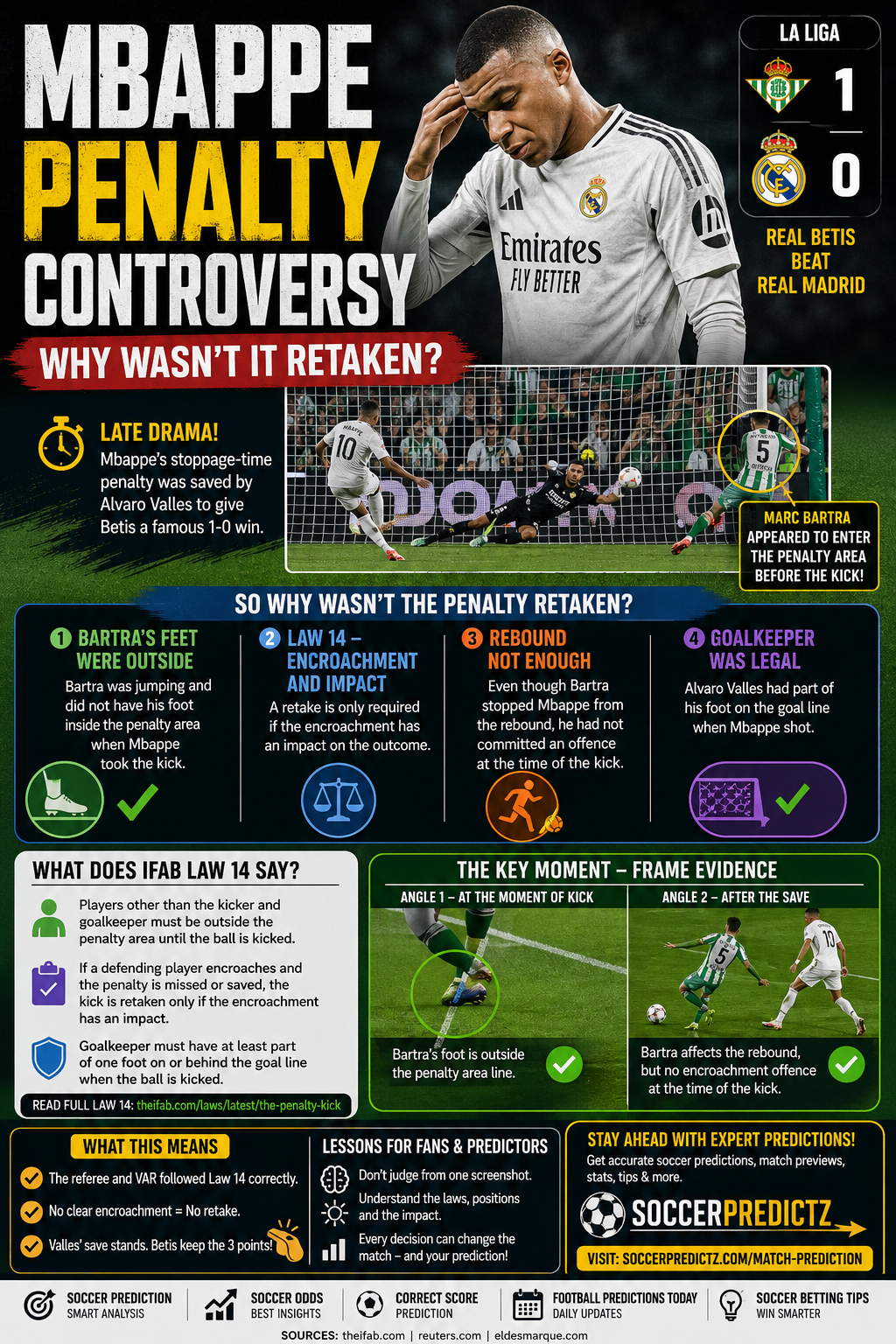
Mbappe Penalty Controversy: Why Wasn’t It Retaken?
Kylian Mbappe’s late penalty miss against Real Betis has become one of the biggest talking points from the latest La Liga action. Real Madrid were chasing an equaliser deep into stoppage time when Mbappe stepped up from the penalty spot, but Betis goalkeeper Alvaro Valles saved the attempt to secure a famous 1-0 victory.
The controversy did not end with the save.
Real Madrid supporters questioned why the penalty was not retaken after Marc Bartra appeared to move into the penalty area before Mbappe struck the ball. Because Bartra subsequently prevented Mbappe from playing the rebound, many fans believed the incident should have resulted in another penalty.
However, the key issue is not simply whether Bartra’s body was inside the penalty area. The decisive question is whether his foot was actually encroaching under the Laws of the Game when Mbappe kicked the ball and whether the encroachment had an impact.
That distinction explains why the referee and VAR allowed the penalty result to stand.
What Happened During Mbappe’s Penalty?
Real Madrid entered the final stages of the match trailing Real Betis 1-0. Troy Parrott had given Betis the lead in the 81st minute after Thibaut Courtois saved a header from Nelson Deossa.
Madrid continued searching for an equaliser. Carlos Espi appeared to score late in the match, but the goal was ruled out for offside following a VAR review.
Mbappe then struck the crossbar before Madrid received another opportunity when Natan committed a late challenge on Vinicius Junior inside the penalty area. The referee awarded Real Madrid a penalty.
Mbappe took responsibility, but his attempt was saved by Valles.
The ball remained in play, creating an opportunity for Mbappe to react to the rebound. However, Bartra intervened and prevented him from finishing the move.
That sequence immediately generated debate among supporters and analysts.
Reuters reported that Valles’ save preserved Betis’ 1-0 victory and ended Real Madrid’s perfect start to the La Liga season under Jose Mourinho.
The controversy centred on Bartra’s position when Mbappe took the kick.
Why Did Fans Want the Penalty Retaken?
The basic argument is straightforward.
Under Law 14, players other than the kicker and goalkeeper must remain outside the penalty area until the ball is kicked. Therefore, if a defending player encroaches and that infringement affects the outcome of a missed penalty, a retake can be required.
In Mbappe’s case, Bartra appeared to be inside the penalty area as the ball was struck. He then became involved in the subsequent play by preventing Mbappe from reaching the rebound.
At first glance, that looks like a clear reason for a retake.
But football’s penalty rules contain an important technical detail: the position of a player’s body is not enough on its own to establish encroachment.
The player’s foot position matters.
This is where the incident becomes much more complicated.
The Key Detail: Bartra Was Jumping
According to Spanish reporting on the incident, Bartra was not actually touching the penalty-area line or the area itself with his foot at the exact moment Mbappe kicked the ball.
His body appeared to be over the area because he was moving or jumping, but the relevant point for the decision was where his foot was positioned.
El Desmarque reported that Bartra did not step into the penalty area before Mbappe’s kick, with the defender’s movement effectively allowing the penalty save to remain valid.
This is a crucial distinction.
A player can have their upper body over the penalty-area line while still not committing encroachment if their feet have not entered the area.
Therefore, a freeze-frame showing Bartra’s torso inside the box does not automatically mean the penalty should be retaken.
For people following soccer prediction and soccer predictions, this is an excellent example of why a single screenshot can sometimes be misleading when analysing football incidents.
What Does IFAB Law 14 Say?
The International Football Association Board, commonly known as IFAB, is responsible for the Laws of the Game.
Law 14 covers penalty kicks.
The current law states that players other than the goalkeeper and penalty taker must be outside the penalty area until the ball is in play. However, the modern law also places emphasis on whether encroachment actually has an impact on the outcome.
For defending players, the consequences depend on what happens after the penalty is taken.
If a defending player encroaches and the penalty is missed or saved, the penalty can be retaken when the encroachment has the relevant impact described by the law.
IFAB’s updated framework was designed to avoid automatically punishing every minor encroachment that has no effect on the penalty.
That means referees and VAR officials have to evaluate both position and impact.
You can read the full official wording in IFAB Law 14 – The Penalty Kick.
Why the Rebound Made the Incident More Complicated
The most frustrating part for Real Madrid supporters was that Bartra was not merely standing near the penalty-area line.
After Valles saved Mbappe’s shot, Bartra prevented Mbappe from getting to the rebound.
That naturally raises the question:
If Bartra was encroaching and then affected the rebound, shouldn’t the penalty have been retaken?
The answer depends on whether Bartra had actually committed encroachment at the moment the ball was kicked.
If his foot had clearly entered the penalty area before the kick and he subsequently played the ball or prevented the opponent from scoring, the situation could potentially satisfy the conditions for a retake.
But if Bartra’s foot remained outside the area when Mbappe kicked the ball, there is no encroachment offence simply because his body was leaning or jumping over the line.
That appears to be the critical reason the original penalty stood.
What About the Goalkeeper?
Another detail that has generated discussion is the position of Betis goalkeeper Alvaro Valles.
Penalty rules also regulate goalkeeper movement.
The goalkeeper must have at least part of one foot touching, in line with, or behind the goal line when the ball is kicked. If the goalkeeper moves illegally and saves the penalty, the kick can be retaken.
In this incident, the available reporting and discussion indicated that Valles had a foot on the line when Mbappe took the penalty.
Therefore, the goalkeeper’s position did not provide a separate reason for a retake.
This is another reason why analysing penalty incidents requires more than simply looking at where players appear to be positioned in a single frame.
VAR and the Mbappe Penalty Decision
VAR naturally became part of the discussion because the incident happened during a match using video review.
VAR can check potential offences during penalty kicks, including goalkeeper and player encroachment.
However, VAR does not automatically overturn every questionable decision.
The evidence must establish a clear offence according to the Laws of the Game. IFAB has previously explained that VAR intervention depends on clear replay evidence, particularly when determining whether a player actually encroached at the relevant moment.
In Mbappe’s case, the technical question was therefore extremely specific:
Was Bartra actually encroaching when Mbappe kicked the ball?
Not:
Did Bartra’s body look like it was inside the box?
That difference is important.
Was the Referee Correct?
Based on the available reporting and the relevant wording of Law 14, the decision not to order a retake can be explained by Bartra’s foot position.
El Desmarque specifically reported that Bartra did not step into the penalty area before Mbappe took the kick.
That means the incident does not appear to provide a straightforward case for a retake.
The controversy is understandable because the visual impression is dramatic. Bartra appears to move into the box and then plays a role in preventing Mbappe from reaching the rebound.
But the Laws of the Game are applied at the exact moment the ball is kicked.
This is why professional refereeing decisions can sometimes look strange when viewed casually.
Why This Matters for Soccer Prediction
Penalty incidents can have a major influence on football analysis.
For anyone researching soccer match prediction, a late penalty can completely change the expected outcome of a game. A goal in stoppage time can turn a defeat into a draw or a draw into a win.
However, analysts should avoid allowing controversial moments to dominate their entire assessment.
Before making a match prediction, it is better to consider:
-
Overall team performance
-
Chances created
-
Expected goals
-
Shots on target
-
Defensive organisation
-
Player availability
-
Recent form
-
Home and away records
-
Tactical changes
-
Set-piece performance
-
Penalty and disciplinary trends
Real Madrid created opportunities against Betis but failed to convert them.
Mbappe had several important chances, including the late penalty, while Betis produced an extremely resilient defensive performance.
Therefore, the result cannot simply be explained by the penalty controversy.
What the Match Means for Football Predictions Today
For people searching for football predictions today, the Real Betis versus Real Madrid match provides an important lesson.
Predictions are probabilities, not guarantees.
Even a heavily favoured team can lose when it fails to convert chances and the opposition defends effectively.
Real Madrid entered the match with a perfect start under Mourinho but suffered their first defeat of the campaign. Betis, meanwhile, moved level with Madrid on nine points after four matches.
That result demonstrates why football prediction models should consider current form rather than relying exclusively on reputation.
The same principle applies to soccer odds.
A team may be heavily favoured by bookmakers because of its squad quality, historical record and recent results. But the actual match can still develop differently.
What Soccer Betting Tips Can Learn From the Incident
The Mbappe penalty controversy also highlights an important principle for people searching for soccer betting tips.
Do not build a prediction solely around one famous player.
Mbappe is one of the world’s most recognised footballers, but even elite penalty takers can miss. Valles produced an excellent save, and Betis’ defensive structure made life difficult for Real Madrid throughout the game.
When assessing a match, it is better to evaluate the entire tactical situation.
For example, before making correct score prediction selections, analysts should consider the likely number of chances, defensive strength, attacking efficiency and expected match tempo.
A single penalty can change the scoreline, but it should not automatically determine the underlying prediction.
Can Mbappe Bounce Back?
The penalty miss will undoubtedly attract significant attention, but elite players regularly respond to difficult moments.
Mbappe had already scored four goals in his opening three league appearances before the Betis match, according to reporting following the game.
One missed penalty does not erase a player’s wider contribution or quality.
The bigger question is how Real Madrid respond collectively.
Their next matches will provide a clearer indication of whether the Betis defeat was simply an isolated setback or evidence of weaknesses that opponents can exploit.
For football tips and future match analysis, the response to this defeat could therefore be more important than the defeat itself.
The Bigger Lesson From the Mbappe Penalty Controversy
The Mbappe penalty incident is a perfect example of how complicated modern football officiating has become.
At first sight, the argument appears simple: Bartra looked inside the box, he affected the rebound, and therefore the penalty should have been retaken.
But the Laws of the Game require a much more precise analysis.
The exact position of the player’s feet at the moment of the kick matters. The question of impact also matters. The goalkeeper’s position must be considered separately, and VAR needs clear evidence before recommending an intervention.
In this case, reporting indicates that Bartra’s foot had not entered the penalty area when Mbappe kicked the ball, which explains why the penalty save was allowed to stand.
Follow More Match Analysis
The incident also demonstrates why detailed football analysis is valuable when evaluating upcoming fixtures.
For more soccer match prediction, team analysis, form discussions and upcoming football insights, visit our SoccerPredictz Match Prediction section.
For the official interpretation of penalty-kick rules, readers can consult IFAB’s Law 14, which explains goalkeeper positioning, encroachment and the circumstances in which a penalty must be retaken.
Readers can also review Reuters’ report on Real Betis’ 1-0 victory over Real Madrid for the match context and Mbappe’s late penalty miss.
Final Verdict: Why Wasn’t Mbappe’s Penalty Retaken?
The short answer is that Bartra’s apparent position inside the penalty area was not, by itself, enough to require a retake.
The decisive issue was whether he had actually encroached at the moment Mbappe kicked the ball. Reporting on the incident indicates that Bartra’s foot had not entered the area at that moment, despite his body appearing to move over the line.
As a result, Valles’ save stood and Real Betis secured a memorable 1-0 victory.
The controversy will likely continue among Real Madrid supporters, but the incident provides a valuable reminder: football rules are often more technical than they initially appear.
For anyone following soccer predictions, match prediction, soccer odds, or correct score prediction, understanding those details can make football analysis more accurate and less dependent on emotion.
In the end, Real Madrid had opportunities to score before the penalty and Mbappe had the biggest opportunity of all.
Valles saved it.
And under the Laws of the Game, the save counted.