
FIFA Transfer Report: $9.89bn Spent in Summer 2026
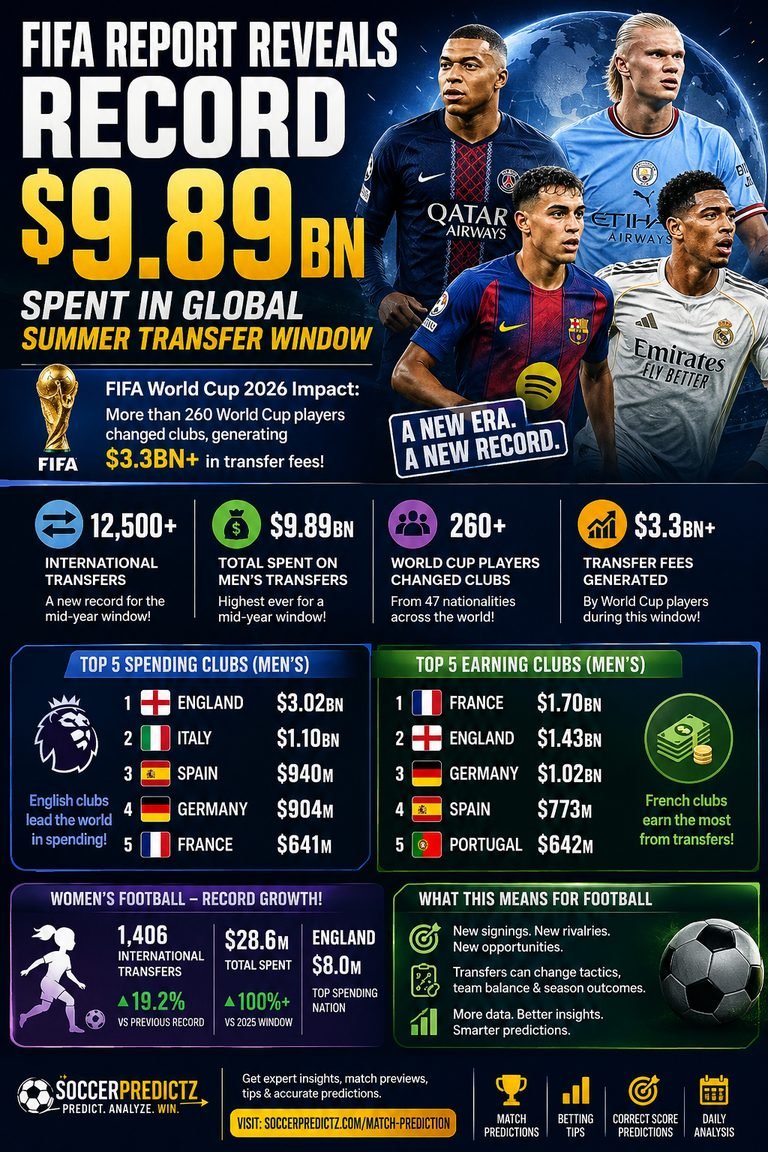
The global football transfer market has reached another historic milestone. According to FIFA’s latest International Transfer Snapshot, clubs spent more than $9.89 billion on international men’s transfer fees during the 2026 mid-year transfer window. More than 12,500 international transfers were registered worldwide, making this one of the biggest transfer periods ever recorded.
The figures cover the period from June 1 to September 2, 2026, and reveal how strongly the FIFA World Cup influenced the global transfer market. More than 260 players who participated in the 2026 World Cup changed clubs during the window, with those transfers representing more than $3.3 billion in combined fees.
For football supporters, the transfer market is more than a collection of headline-making deals. New signings can completely change the strength, tactics and expectations of clubs. That makes transfer activity especially important for people following soccer prediction, football prediction, match analysis and upcoming competitions.
FIFA Confirms a Record-Breaking Transfer Window
FIFA’s report shows just how significant the 2026 summer window became. Men’s professional football recorded more than $9.89 billion in international transfer fees, the highest amount ever recorded for a mid-year transfer window.
The number of international transfers also passed 12,500. That is a new record for the mid-year registration period and demonstrates the increasingly international nature of modern football.
The transfer market has become increasingly strategic for clubs. Teams are no longer simply buying famous players. Recruitment departments use performance data, tactical analysis, physical metrics and long-term projections to identify players who can improve a squad.
This development is also important for fans interested in soccer predictions. A team’s transfer activity can influence its expected performance, especially when a club adds players capable of improving its attack, midfield or defensive structure.
The World Cup Had a Major Impact
The biggest story behind the numbers is the influence of the 2026 FIFA World Cup.
The tournament provided players with an enormous global stage. Strong performances against international opposition can significantly increase a player’s visibility and market value. FIFA reported that 267 World Cup players from 47 nationalities changed clubs during the mid-year window, accounting for more than $3.3 billion in transfer fees.
This represents more than one-third of the total $9.89 billion spent on international men’s transfers.
The connection between major tournaments and transfer activity is understandable. Clubs can evaluate players under intense pressure while competing against some of the world’s strongest national teams.
For supporters looking at football predictions today, this can be an important factor. A player who performed exceptionally well at the World Cup may enter the new season with greater confidence, while a newly transferred player may require time to adapt to a different tactical system.
English Clubs Lead Global Transfer Spending
English clubs were the biggest spenders in FIFA’s international transfer data.
According to FIFA, English clubs invested more than $3.02 billion in international transfer fees during the window. Italy followed with approximately $1.1 billion, while Spain spent around $940 million, Germany $904 million and France $641 million.
England’s dominance is hardly surprising given the financial strength of the Premier League.
However, it is important to understand that FIFA’s international transfer figures are not exactly the same as domestic league spending figures reported elsewhere. FIFA’s figure focuses on international transfers, while some league-level calculations also include transfers between clubs within the same country.
That distinction is important when analyzing soccer odds or making a soccer match prediction. Transfer spending alone does not automatically determine which team will perform better.
A club can spend hundreds of millions but still struggle if its new players do not fit the manager’s tactical approach.
France Leads Transfer Income
While English clubs dominated spending, French clubs recorded the highest total income from international transfer fees.
French clubs received approximately $1.7 billion in transfer fees. English clubs followed with $1.43 billion, Germany generated $1.02 billion, Spain $773 million and Portugal $642 million.
This highlights another important part of the modern football economy: player development.
French clubs have established a strong reputation for developing young footballers and subsequently selling them to bigger clubs. This model allows clubs to generate significant revenue while maintaining competitive squads.
For analysts, transfer income can be just as interesting as spending. A club that sells an important player may receive substantial financial compensation but could suffer a sporting decline if it cannot replace that player’s production.
Therefore, anyone studying match prediction should consider both incoming and outgoing transfers rather than looking only at headline purchases.
Big Transfers Can Change the Football Landscape
The 2026 transfer window featured several major moves involving high-profile players.
Reuters reported that World Cup stars were responsible for more than $3.3 billion in combined transfer fees. Among the notable moves were Rodri’s transfer from Manchester City to Barcelona and Bradley Barcola’s move from Paris Saint-Germain to Liverpool.
These types of transfers can have a direct impact on the competitive balance of major leagues.
A world-class midfielder joining a title contender can strengthen possession and defensive control. A prolific winger joining an attacking team can create more goalscoring opportunities. Likewise, losing a key player can force a manager to change formations or tactical priorities.
This is why transfer news should be considered alongside injuries, form, fixtures and historical performance when developing soccer betting tips.
Transfer fees tell us how much clubs invested, but they do not tell the complete sporting story.
Why Transfer Activity Matters for Soccer Prediction
Football prediction has become increasingly data-driven.
When attempting a correct score prediction, analysts may consider dozens of variables, including:
-
Recent team form
-
Home and away performance
-
Goals scored and conceded
-
Player availability
-
Injuries and suspensions
-
Tactical formations
-
Head-to-head records
-
Expected goals
-
Transfer activity
-
Managerial changes
-
Strength of opposition
The 2026 transfer window adds another important variable.
A club that signs several new players may initially experience an adjustment period. Players need to understand the manager’s tactics, build relationships with teammates and adapt to a new league.
On the other hand, a team that keeps most of its successful squad may benefit from greater continuity.
For this reason, transfer analysis should not be separated from match analysis. It should become part of a broader process used to understand how teams may perform during the season.
Women’s Football Also Sets New Records
The growth of the transfer market was not limited to men’s football.
FIFA reported 1,406 international transfers in women’s professional football, an increase of 19.2% compared with the previous record. International transfer spending more than doubled compared with the corresponding 2025 window, reaching an all-time high of $28.6 million.
English clubs were once again the biggest spenders, investing approximately $8 million. Spain followed with $6.6 million, Germany with $4.9 million, the United States with $2.9 million and Italy with $2.1 million.
Swedish clubs received the highest value of transfer fees at around $4.2 million.
These numbers demonstrate the continued professionalization and international growth of women’s football.
As women’s competitions attract greater audiences and investment, interest in soccer predictions and match analysis is also likely to expand across more leagues and tournaments.
How New Transfers Could Affect the 2026–27 Season
The real impact of the record transfer window will be measured on the pitch.
Some clubs have strengthened their squads significantly, while others have focused on developing young players or maintaining continuity.
The first few months of the season could therefore be particularly interesting. Teams with many new signings may need time to develop chemistry, while established squads may have an early advantage.
For supporters looking for reliable football tips, it is important to avoid judging a transfer purely by its price tag.
A $100 million player is not guaranteed to perform better than a $20 million signing. Tactical compatibility, playing time, team structure and managerial philosophy can all influence a player’s impact.
The best football prediction analysis should therefore combine transfer information with measurable team performance.
Transfer Spending Does Not Guarantee Success
One of the biggest mistakes football fans can make is assuming that the biggest spender will automatically become the strongest team.
Football does not work that way.
A successful team needs balance. It needs defensive organization, midfield control, attacking efficiency, squad depth and a tactical system that allows individual players to perform at their best.
High transfer spending can improve a team’s resources, but it cannot guarantee trophies.
This is particularly relevant when evaluating soccer odds. Market expectations may sometimes place excessive emphasis on famous players or expensive signings. Smart analysis requires looking beyond reputation.
Before making a soccer match prediction, fans should examine how new players fit into the team’s existing structure and whether the manager has a clear plan for integrating them.
What the Record $9.89 Billion Means for Football
The record spending figure is evidence of football’s enormous global economic reach.
More than $9.89 billion in international men’s transfer fees during a single mid-year window demonstrates how valuable elite football has become. The World Cup amplified this activity, with hundreds of participating players changing clubs after the tournament.
At the same time, the record number of women’s transfers and increased spending show that the football economy is expanding beyond its traditional boundaries.
For fans, the most exciting part is what happens next.
Transfers create new rivalries, tactical battles and opportunities for clubs to challenge for domestic and international trophies. They also create new questions for analysts attempting football predictions today.
Which new signing will make the biggest impact? Which club has recruited most effectively? Which team will struggle after losing a key player? And which under-the-radar transfer could become a season-defining move?
These questions will shape football discussions throughout the 2026–27 campaign.
Follow the Latest Match Analysis
Transfer news provides valuable context, but actual results remain the ultimate test of a team’s strength.
If you want to follow upcoming fixtures and detailed football analysis, explore our soccer match prediction and analysis section for insights into upcoming games.
Combining transfer developments with team form, player availability, tactical information and historical statistics can create a more complete approach to match prediction.
For additional coverage of the FIFA transfer report and the impact of the World Cup on the market, see FIFA’s official transfer-system report and Reuters’ report on World Cup stars and record transfer spending.
Final Thoughts
FIFA’s record $9.89 billion international transfer spending figure underlines the extraordinary scale of the modern football market. More than 12,500 international transfers were registered during the 2026 mid-year window, while World Cup players generated more than $3.3 billion in combined transfer fees.
English clubs led global international spending, French clubs generated the highest transfer income, and women’s football achieved significant new records of its own.
The financial numbers are impressive, but their sporting consequences could be even more significant.
As the 2026–27 season develops, supporters will discover which clubs converted massive investment into stronger performances. For anyone following soccer prediction, soccer betting tips, correct score prediction and football prediction, the transfer market provides another valuable layer of information.
Ultimately, money can buy talent—but only the right combination of talent, tactics, teamwork and consistency can produce results on the football pitch.