
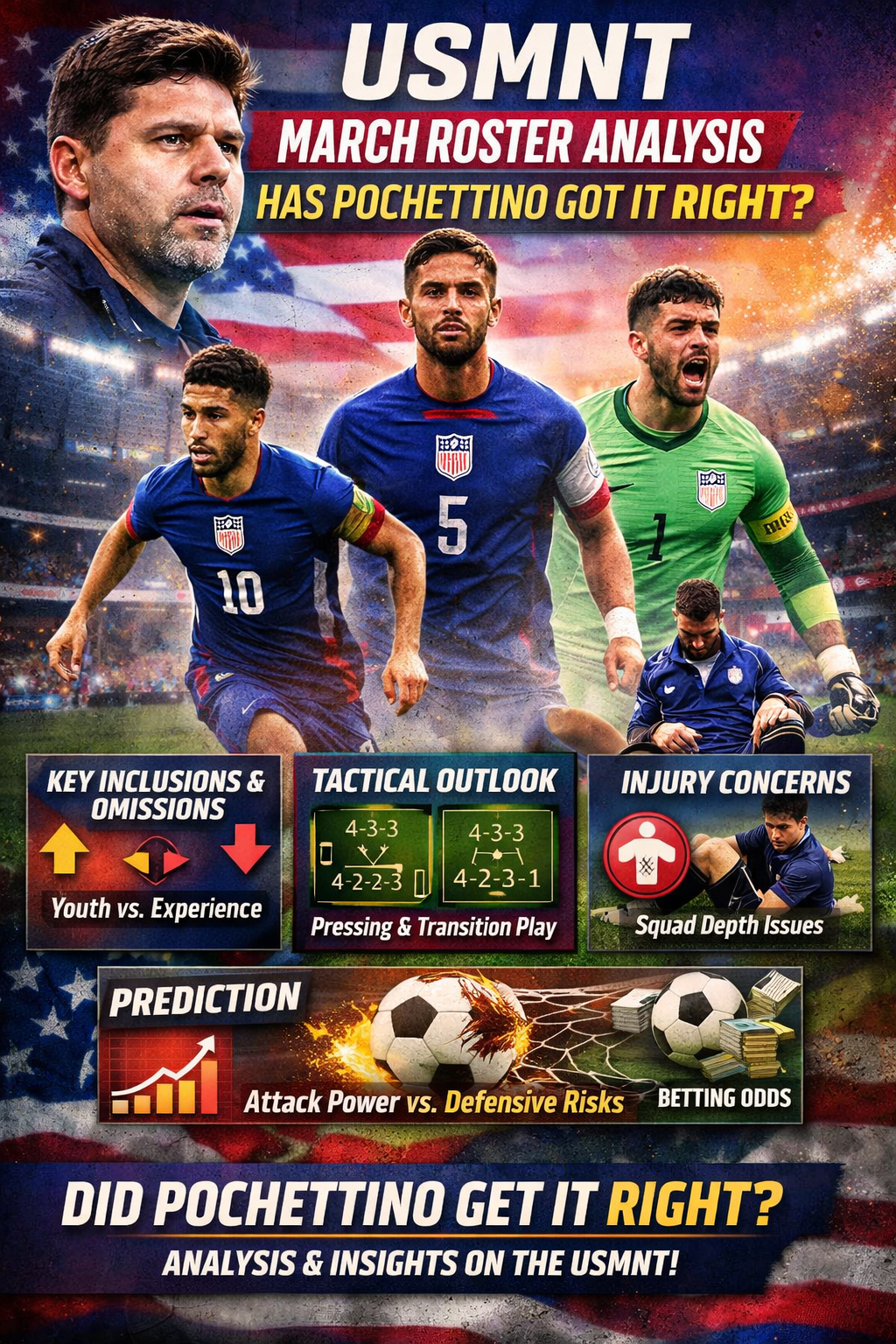
USMNT March Roster Analysis: Has Pochettino Got It Right
The unveiling of the United States Men’s National Team (USMNT) March roster under Mauricio Pochettino marks a significant moment in the program’s ongoing evolution. As one of the most tactically progressive managers in modern football, Pochettino brings a philosophy rooted in intensity, positional discipline, and data-driven decision-making.
Naturally, his first few roster selections are being closely scrutinized—not only by fans and pundits but also through advanced soccer prediction models, team form analysis, and player performance metrics. These tools provide a deeper understanding of whether the chosen squad is equipped to meet both immediate competitive demands and long-term developmental goals.
This article offers a comprehensive 1500-word evaluation of the USMNT March roster, integrating match preview insights, betting odds trends, lineup predictions, head-to-head data, injury updates, tactical analysis, and expected goals (xG) to determine whether Pochettino has made the right calls.
Strategic Context Behind the March Roster
Before assessing individual selections, it is essential to understand the broader strategic context. International football operates under unique constraints—limited training time, fluctuating player availability, and varying levels of competition. As a result, roster construction must balance familiarity with experimentation.
From a team form analysis standpoint, Pochettino appears to prioritize players who are actively contributing at club level. This aligns with modern soccer prediction frameworks, where recent performance data carries more weight than historical reputation.
Moreover, the March window is often used as a testing ground ahead of major tournaments. This explains why some selections may appear unconventional when viewed through a purely results-oriented lens.
For readers interested in advanced statistical context, platforms like
👉 https://fbref.com/en/
offer detailed breakdowns of player contributions, including xG, progressive passes, and defensive actions.
Squad Composition: Balance Between Youth and Experience
A defining feature of this roster is its blend of youth and experience. Pochettino has historically shown a willingness to trust younger players, provided they meet his tactical and physical requirements.
Youth Inclusion
The inclusion of emerging talents reflects a forward-looking approach. From a player performance metrics perspective, many of these players rank highly in:
-
Expected goals (xG) contribution
-
Pressing efficiency
-
Progressive ball carries
These metrics are critical within Pochettino’s system, which emphasizes quick transitions and vertical movement.
Experienced Core
At the same time, the presence of experienced internationals ensures a degree of stability. These players contribute valuable head-to-head data, having performed in high-pressure international fixtures.
However, the balance is delicate. Too much reliance on youth can lead to inconsistency, while over-dependence on veterans may hinder tactical evolution. Pochettino’s selection suggests an attempt to strike equilibrium.
Tactical Identity: What the Roster Reveals
One of the most effective ways to evaluate a squad is through tactical analysis. A roster is not merely a collection of talented individuals—it is a reflection of a manager’s intended playing style.
Expected Formation and Structure
Based on lineup predictions and historical trends, the USMNT is likely to adopt:
-
A 4-3-3 system for attacking fluidity
-
A 4-2-3-1 variation for defensive stability
These formations allow for:
-
High pressing in advanced areas
-
Quick transitions from defense to attack
-
Positional rotations in midfield
Pressing and Defensive Shape
Pochettino’s teams are known for their aggressive pressing. This requires players with:
-
High stamina
-
Tactical awareness
-
Ability to recover possession quickly
From a soccer prediction standpoint, pressing efficiency is a key determinant of match outcomes, particularly against technically proficient opponents.
For deeper insights into modern tactical trends,
👉 https://theanalyst.com/
provides extensive coverage of pressing systems and transition-based football.
Key Players: Data-Driven Insights
Evaluating individual players through player performance metrics provides clarity on why certain selections were made.
Attackers
The attacking unit is built around players with strong expected goals (xG) and shot-creating actions. These metrics indicate:
-
Ability to generate high-quality chances
-
Consistency in goal-scoring positions
-
Efficiency in final-third decision-making
Such attributes are essential in Pochettino’s system, which prioritizes direct attacking play.
Midfielders
Midfield selection appears focused on versatility. Key metrics include:
-
Progressive passes
-
Ball recoveries
-
Press resistance
These players act as the engine of the team, linking defense and attack while maintaining structural integrity.
Defenders
Defensive selections emphasize:
-
Ability to play in a high line
-
Comfort in possession
-
Aerial and physical dominance
However, team form analysis suggests that defensive consistency may be an area of concern, particularly against teams that excel in counter-attacking situations.
Notable Omissions and Their Implications
No roster selection is without controversy. Several notable omissions have sparked debate, particularly among analysts who rely on head-to-head data and historical performance.
From a betting odds perspective, the absence of experienced players can introduce uncertainty. Bookmakers often factor in squad familiarity and cohesion when setting odds, meaning that unconventional selections can influence market perceptions.
At the same time, such decisions may be necessary to align with long-term tactical objectives. Pochettino’s willingness to make bold choices suggests a commitment to system integrity over short-term appeasement.
Injury Updates and Squad Depth
Injuries play a crucial role in shaping any international roster. Recent injury updates have forced adjustments, leading to opportunities for fringe players.
This highlights the importance of squad depth—a factor often overlooked in traditional analysis but central to modern soccer prediction models.
Players stepping into the squad must quickly adapt to tactical demands, which can impact overall team cohesion. However, it also provides valuable experience that can strengthen the team in future competitions.
For official squad news and updates,
👉 https://www.ussoccer.com/
remains the most reliable source.
Predictive Analysis: Strengths and Weaknesses
By integrating soccer prediction tools, lineup predictions, and tactical analysis, we can identify key strengths and weaknesses of the current roster.
Strengths
-
Attacking Potential
High xG contributors suggest the ability to create and convert scoring opportunities. -
Tactical Flexibility
Multiple formation options provide adaptability against different opponents. -
Energy and Pressing
Younger players enhance pressing intensity and recovery speed.
Weaknesses
-
Defensive Vulnerability
High defensive lines can be exposed by quick transitions. -
Inexperience in Key Areas
Lack of seasoned players may impact decision-making under pressure. -
Consistency Concerns
Variability in performance is likely, especially in early stages. - Our Prediction : https://soccerpredictz.com/match-prediction/
Betting Odds and Match Predictions
From a betting odds standpoint, the USMNT enters upcoming fixtures as a moderately strong contender, but not without risk. Odds are influenced by:
-
Recent team form
-
Player availability
-
Historical head-to-head data
For comprehensive odds comparison,
👉 https://www.oddschecker.com/football
offers real-time insights into market expectations.
Match Prediction Outlook
Based on current data:
-
Likely to dominate possession against weaker opponents
-
Competitive against similarly ranked teams
-
Potential struggles against elite, counter-attacking sides
Long-Term Vision vs Short-Term Results
One of the central questions surrounding this roster is whether it prioritizes long-term development over immediate success.
Pochettino’s track record suggests a focus on building sustainable systems rather than chasing short-term results. This approach may lead to initial inconsistency but often yields long-term benefits.
From a soccer prediction perspective, teams undergoing tactical transitions typically experience performance fluctuations before stabilizing.
Final Verdict
So, has Pochettino got his March roster right?
From a comprehensive analytical standpoint, the answer is nuanced.
-
Strategically, the roster aligns with modern football principles and long-term objectives.
-
Tactically, it supports a high-intensity, pressing-based system.
-
Predictively, it offers both promise and uncertainty.
While not without its risks, the selection reflects a clear vision—one that prioritizes adaptability, data-driven performance, and future growth.
Prediction Summary
Based on expected goals (xG), betting odds, team form analysis, and tactical insights:
-
Strong attacking performances expected
-
Occasional defensive lapses likely
-
Overall results: mixed but promising
Conclusion
The USMNT March roster under Mauricio Pochettino represents a bold step toward a more modern, analytically driven approach to international football. By integrating soccer prediction models, player performance metrics, and tactical analysis, it becomes clear that this is not merely a squad selection—it is a statement of intent.
Whether the results immediately reflect this vision remains to be seen. However, the foundation being laid suggests that the USMNT is moving toward a more cohesive and competitive future.